

Related Podcast Episode
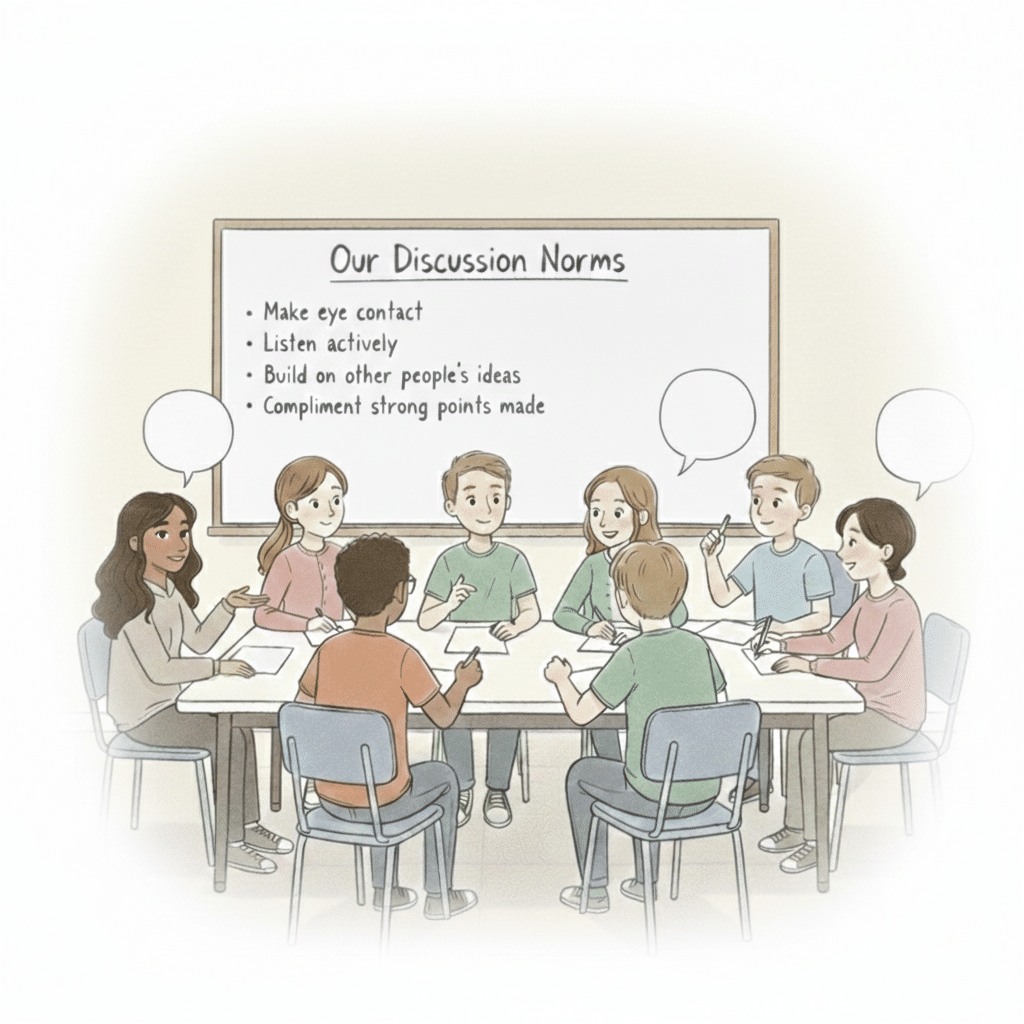
In many classrooms today, students are hesitant to communicate their thinking. They sit silently, wait to be called on, and avoid talking with peers about their ideas. Even when prompted, many offer short, minimal responses. They avoid seeking clarification when they are confused. I often observe students working side by side without actually engaging with each other or explaining their reasoning out loud. Even when tasks are designed to be “pairs do” or small-group endeavors, many students choose to work in isolation.
Communication is the bridge between thinking and learning. When students can’t or won’t communicate, learning stalls. Students can have brilliant ideas, urgent questions, and genuine insights, but those thoughts need to be expressed, explored, examined, and refined through interaction to deepen understanding.
For many students, the issue isn’t a lack of ideas. It is a lack of confidence in their ability to communicate them clearly. Without explicit teaching and support, students may retreat into silence or rely on AI rather than developing the skills to articulate their own thinking. This is why clarity in communication matters so much.
Clarity in communication yields more confident and engaged students. Students who know how to express their ideas, navigate misunderstandings, and adjust their language are more likely to participate, ask questions, and take intellectual risks. At a time when many students are retreating into silence and sitting on the sidelines, we must equip them to clearly express themselves and take an active role in the learning process.
This post is part of the Skills Before Tools series based on my K-12 AI Implementation Guide. Each post unpacks one of the five core throughline skills that students need to use AI strategically and responsibly.
Like purpose setting and questioning in the last post in this series, clarity in communication develops over time and spans speaking, listening, and writing. It requires explicit instruction, support, practice, and reflection. When schools prioritize this skill, students are better prepared to use AI strategically, responsibly, and in service of their learning rather than as a substitute for it.
Why Clarity in Communication Is a Foundational Skill for AI Use
Clarity in communication shapes how students interact with learning itself. It determines whether ideas can be shared, feedback can be understood and applied, and collaboration can move thinking forward. When students can clearly express what they mean, what they are trying to do, and where they are struggling or stuck, they are better positioned to learn both independently and with others.
The ability to communicate clearly matters even more when they begin using AI. AI systems respond directly to the language students use. Unlike a teacher who can read between the lines, observe body language, hear tone of voice, or ask clarifying questions, AI relies entirely on patterns in language to interpret meaning. It doesn’t “understand” intent the way humans do. This means that vague questions or queries lacking context and detail often yield unhelpful responses. In workshops, I emphasize that, when using AI, the stronger the input, the stronger the output. Clear communication with AI yields responses that are more relevant, useful, and aligned with the students’ goals and needs (Sawalha, Taj & Shoufan, 2024).
What is often labeled a “prompt problem” or a failing in the construction of the question is really a communication problem. Students may know what they want help with but struggle to articulate it clearly. Unclear communication can lead AI to generate responses that sound helpful but miss the point. Because the language is confident and fluid, students may trust the response without realizing it doesn’t actually align with what they were trying to learn or improve. As a result, AI can unintentionally derail learning or take over thinking rather than support it.
When we explicitly teach and practice communication skills, students remain in control of the learning process. They develop the ability to explain their thinking, revise their word choice and sentence structure, and reflect on how their wording shapes the responses they receive. This positions them to evaluate whether feedback is actually useful and aligned with their intent. They can advocate for themselves, make informed decisions, and keep AI in a supporting role rather than allowing it to take over the cognitive work.
Clarity in Communication
Clarity in communication is the ability to express one’s thinking in a way that others can understand. It involves choosing words intentionally, providing relevant context, and adjusting language when our intent is misunderstood. In learning environments, clarity allows ideas to move beyond a student’s internal thinking into shared spaces where they can be examined, challenged, and refined.
This skill shows up in multiple formats. Students communicate verbally when they explain their reasoning or participate in a discussion. They listen carefully, considering others’ ideas and responding thoughtfully. They communicate through writing when they organize and articulate their thinking for an audience. Across all of these forms, clarity is about being understood.
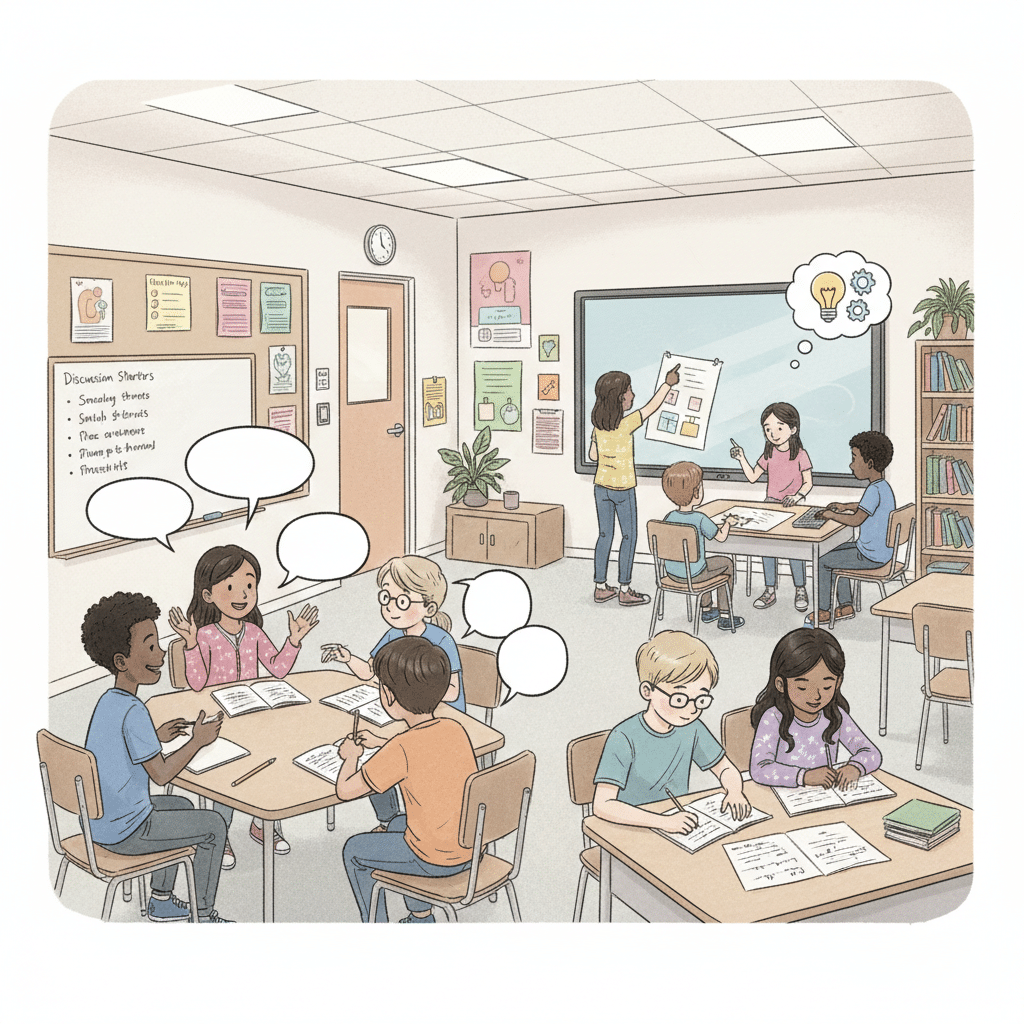
Research consistently shows that communication is foundational to learning and success in life (Thornhill-Miller et al., 2023). Students who can articulate their thinking, explain concepts, make connections, and generate inferences perform better academically and retain information more effectively (Jarret, 2018). The ability to explain ideas, ask for clarification, and engage in dialogue not only supports academic performance but also fosters collaboration and problem-solving well beyond school (Hanover Research, 2014).
In classrooms, clarity in communication directly supports metacognition. When students put their thinking into words, they become more aware of how they are thinking. This process of articulation helps students notice gaps in their understanding, refine incomplete ideas, and make more intentional decisions about next steps. As a result, communication deepens learning.
Clarity in Communication Across Grade Levels in K-12 Classrooms
In an AI-rich learning environment, clarity takes on new urgency. Unclear communication that lacks context and detail yields generic, surface-level responses that are misaligned with the student’s needs. When students communicate with precision (and a clear purpose), AI can provide more targeted and relevant support.
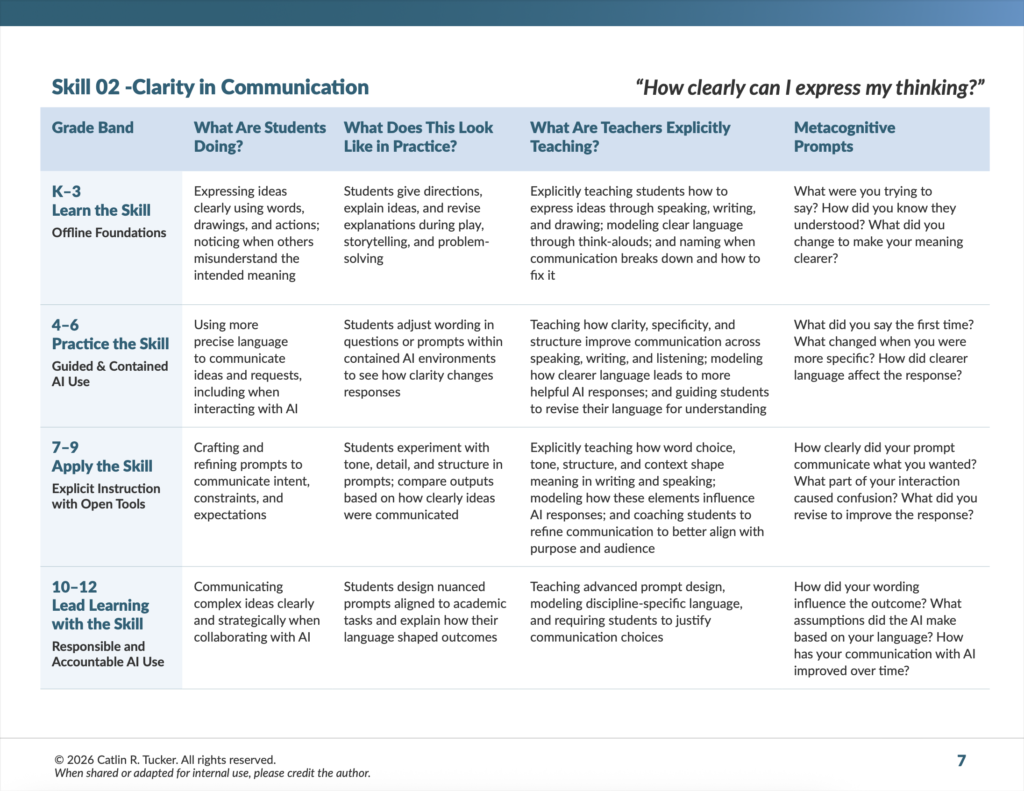
Clarity in communication develops gradually as students learn to express ideas, listen for understanding, and revise their language when meaning breaks down. Across grade levels, the goal remains consistent: to help students make their thinking understandable to others. What changes over time is the complexity of the ideas, the expectations for precision, and the degree of responsibility students take for repairing misunderstandings.
While the context, complexity, and tools evolve, clarity is always about helping students move from vague or internal thinking to communication that supports learning.
Grades K-3: Learning to Express Meaning
In the earliest grades, clarity in communication begins with helping students express ideas in simple, concrete ways. Students talk through their thinking during play; explain how they solved a problem; or describe what they are trying to do, build, draw, or write. Misunderstandings are common and expected. They provide teachable moments and learning opportunities.
Teachers explicitly teach oral and written communication skills, model clear language, help students navigate moments when communication breaks down, and identify examples of unclear ideas. Students try again, revising their explanations and using words, drawings, gestures, or demonstrations. Reflection focuses on helping students notice whether others understood their meaning. Teachers can ask questions like:
- Did your friend understand what you meant?
- What did you say or show to help them understand?
- What could you change to make your idea clearer?
- Can you say that in a different way?
At this stage, clarity is about building confidence and helping students see communication as flexible and revisable rather than something they get right or wrong.
Grades 4-6: Practicing Precision and Detail
As students move into upper elementary grades, clarity becomes more intentional. Students begin to recognize that adding detail, organizing ideas, and choosing words carefully helps others understand their thinking. They practice explaining their reasoning, giving directions, and asking questions that reflect what they want to know or learn.
When AI is introduced in guided, contained environments, students can observe how changes in their wording affect the responses they receive. Teachers support students in writing and revising questions or explanations and comparing outcomes. This helps students notice how clearer communication leads to more relevant answers and support. Reflection at this stage emphasizes how specificity improves understanding. Teachers ask questions like:
- What details did you include to make your explanation clear?
- How did changing your words change the response you received?
- What information was missing that may have caused confusion?
- How could you reword this to be more specific?
These prompts encourage students to recognize the importance of precision and how it directly impacts the quality of the answers, feedback, and support they receive.
Grades 7-9: Communicating Intent, Context, and Constraints
In middle and early high school, students move beyond simply explaining their thinking and begin learning how to communicate with more intentionality. At this stage, students articulate their goals, explain why the work matters, and identify the conditions or expectations that guide it.
Students learn that communicating intent helps others understand their goal. Providing context situates that goal within a task, subject, or line of reasoning. Naming constraints, such as criteria, focus areas, or boundaries, help narrow responses and avoid misalignment between the request and response. When any of these elements—intent, context, constraints—are missing, feedback and support from peers, teachers, and AI often fall short.
Teachers provide explicit instruction in how word choice, structure, tone, and detail shape meaning. This includes introducing prompt engineering as the intentional design of questions and requests to AI systems. Students analyze strong examples of prompts to identify key features. They practice writing and revising prompts, explanations, and questions to clarify their intent and provide necessary context. They experiment with different prompt structures, compare responses generated from vague versus clearly written requests, and analyze where confusion or misalignment occurred.
Students begin to see prompt design not as a technical skill separate from communication, but as a critical component of clarity. The same principles that help them communicate effectively with peers and teachers also help them get better responses from AI. Reflection focuses on diagnosing communication breakdowns and making intentional revisions. Teachers ask questions like:
- What is your goal and did you clearly communicate it in your prompt?
- What context does the AI or person need to understand what you are asking?
- What constraints or criteria should guide the response?
- How did changing specific words or adding details change the output?
- Where did the miscommunication happen? How can you revise your language to correct the issue?
Students begin to understand the importance of clear communication in the learning process. And they internalize the process of refining how they communicate intent, context, and constraints, whether they are interacting with people or AI systems.
Grades 10-12: Communicating with Purpose, Precision, and Accountability
By 10th grade, we expect students to communicate complex ideas clearly and justify their choices. They design nuanced explanations, architect prompts that align with academic and real-world tasks, and explain how their word choice and language shaped the responses they received.
At this level, prompt engineering becomes more sophisticated and discipline-specific. Students learn to architect prompts that reflect the conventions, vocabulary, and expectations of different classes and fields of study. They anticipate misunderstandings, provide sufficient context and detail, and revise communication or give feedback when outcomes do not align with their intent. This includes critically evaluating AI outputs and iteratively refining their prompts until the responses meet their needs.
Teachers model discipline-specific language and require students to explain their choices when communicating. Students document their revision process, explaining how they refined prompts to better align with their goals. They also consider the ethical implications of their prompts, including how tone, framing, and specificity can influence AI outputs, potentially introducing bias or misrepresenting information.
Reflection emphasizes intentionality, strategic communication, and critical evaluation. Teachers ask questions like:
- What elements and information did you include in your prompt and why?
- How might your language influence or limit the response you receive?
- What assumptions did you make about what the AI, reader, or listener already knew?
- How did you revise your prompt to align more closely with your intent or goal?
- How do you evaluate whether an AI response is useful, accurate, or appropriate for your purpose? What questions do you need to ask?
At this level, the students’ ability to communicate clearly is tied to accountability and intentionality. Students are responsible not only for what they say but also for how effectively their language supports understanding, learning, and ethical use of AI. They understand that strong communication skills give them agency over the tools they use rather than allowing those tools to dictate the direction of their work.
Why Clarity in Communication Matters More Than Ever
Clarity in communication has always been foundational to learning. What has changed is the environment in which students are learning to communicate. Today’s students are navigating more complex tasks, interacting with more sources of information, and using a range of tools and technologies that weren’t available even five years ago.
When students communicate with AI, they rarely receive pushback or requests for clarification. The system generates a response regardless of whether the input was clear, thoughtful, or aligned with the student’s actual goal. Without the communication skills to recognize these gaps, students may accept misaligned or inaccurate responses, disengage when outputs don’t make sense, or lose sight of what they were originally trying to accomplish.
Clarity also plays a critical role in sustaining student agency. When students can articulate what they are trying to do and revise their language to get closer to what they need, they stay in control of their learning. They can evaluate when feedback from people or systems is actually useful. They can advocate for themselves and their needs. And, they can make informed decisions rather than passively accepting whatever response they are given.
Up Next: Evaluation & Judgment
In the next post in this Skills Before Tools series, I’ll focus on evaluation and judgment, two essential skills students need to use AI effectively.
If you are looking for support as you navigate these conversations about AI implementation in your school or district, you can download the Skills Before Tools: A K-12 AI Implementation Guide. The guide is designed to help teams ground AI decisions in shared language, developmental progressions, and transferable skills. I am also available to support this work through professional learning, coaching, or discussions on implementation.
Download your copy of Skills Before Tools: A K-12 Guide to AI Implementation.
Works Cited
Hanover Research. (2014). Incorporating soft skills into the K–12 curriculum. District Administration Practice.
Jarret, C. (2018). Self-explanation is a powerful learning technique, according to meta-analysis of 64 studies involving 6000 participants. The British Psychological Society. Retrieved from www.bps.org.uk/research-digest/self-explanation-powerful-learning-technique-according-meta-analysis-64-studies
Sawalha, G., Taj, I., & Shoufan, A. (2024). Analyzing student prompts and their effect on ChatGPT’s performance. Cogent Education, 11(1), 2397200. https://doi.org/10.1080/2331186X.2024.2397200
Thornhill-Miller, B., Camarda, A., Mercier, M., Burkhardt, J. M., Morisseau, T., Bourgeois-Bougrine, S., … & Lubart, T. (2023). Creativity, critical thinking, communication, and collaboration: Assessment, certification, and promotion of 21st century skills for the future of work and education. Journal of Intelligence, 11(3), 54.
No responses yet