
Guest Post by Robert Mayfield
For most of my life, I’ve been a rule-following, do-things-“by-the-book” kind of person. My early years in the classroom were no different. I wanted to teach the “right way.” I spent a lot of time talking and transferring information. Students copied notes into their “interactive notebooks.” I checked for understanding with cold calls, random popsicle sticks, or calling on the same eager hand-raisers.
I assumed students understood my daily recitation of PowerPoint notes because they were awake (usually), facing the front of the room, writing stuff down. Without realizing it, I had created a fully functioning compliant classroom.
For nearly a decade, I repeated that instructional design. I projected notes on the big screen (the OG version of screen time) and used low-level DOK worksheets. I graded EVERYTHING. Then I encountered EduProtocols and blended learning.
I first heard Jon Corippo, co-creator of EduProtocols, at the CISC Conference in 2016. I began experimenting with EduProtocols after the first book was published in 2018, although it took several years before I became what Jon calls a “heavy user.”
Three years later, I attended one of Catlin’s keynotes on blended learning, teacher burnout, and unsustainable workflows. After Catlin’s 2019 keynote, I was convinced I was ready to transform my classroom with blended learning, too. Jon and Catlin’s ideas challenged much of what I thought I knew about effective instruction. My carefully constructed “game of school” suddenly didn’t feel quite so effective.
I knew there was a better way. Knowing how to make it sustainable was another story.
The Planning Problem
Teachers today are expected to differentiate, provide feedback, foster student agency, incorporate technology, and design learning that meets an increasingly wide range of student needs. Most teachers want to do all of these things. The challenge is that designing for diverse learners takes time and intentional planning, and teachers are already stretched thin.
As a result, worthwhile goals can get relegated to the growing list of EduBuzzwords we hear in professional development but struggle to implement sustainably. I understood the premise of blended learning, but regularly planning three or four different Station Rotation activities felt overwhelming. Working with a small group where I could truly differentiate sounded amazing. Releasing control while everyone else worked independently? Not so much.
From Repetitive to Repeatable Structures
I eventually realized stronger instructional design didn’t require me to keep creating more. It needed to become repeatable, not repetitive.
Repeatable means the structure of a learning experience becomes familiar while the content and thinking change. Students don’t need new directions, workflows, and activities every day. They need familiar structures that allow them to do new thinking every day.
Repetitive
Same task. Different content.
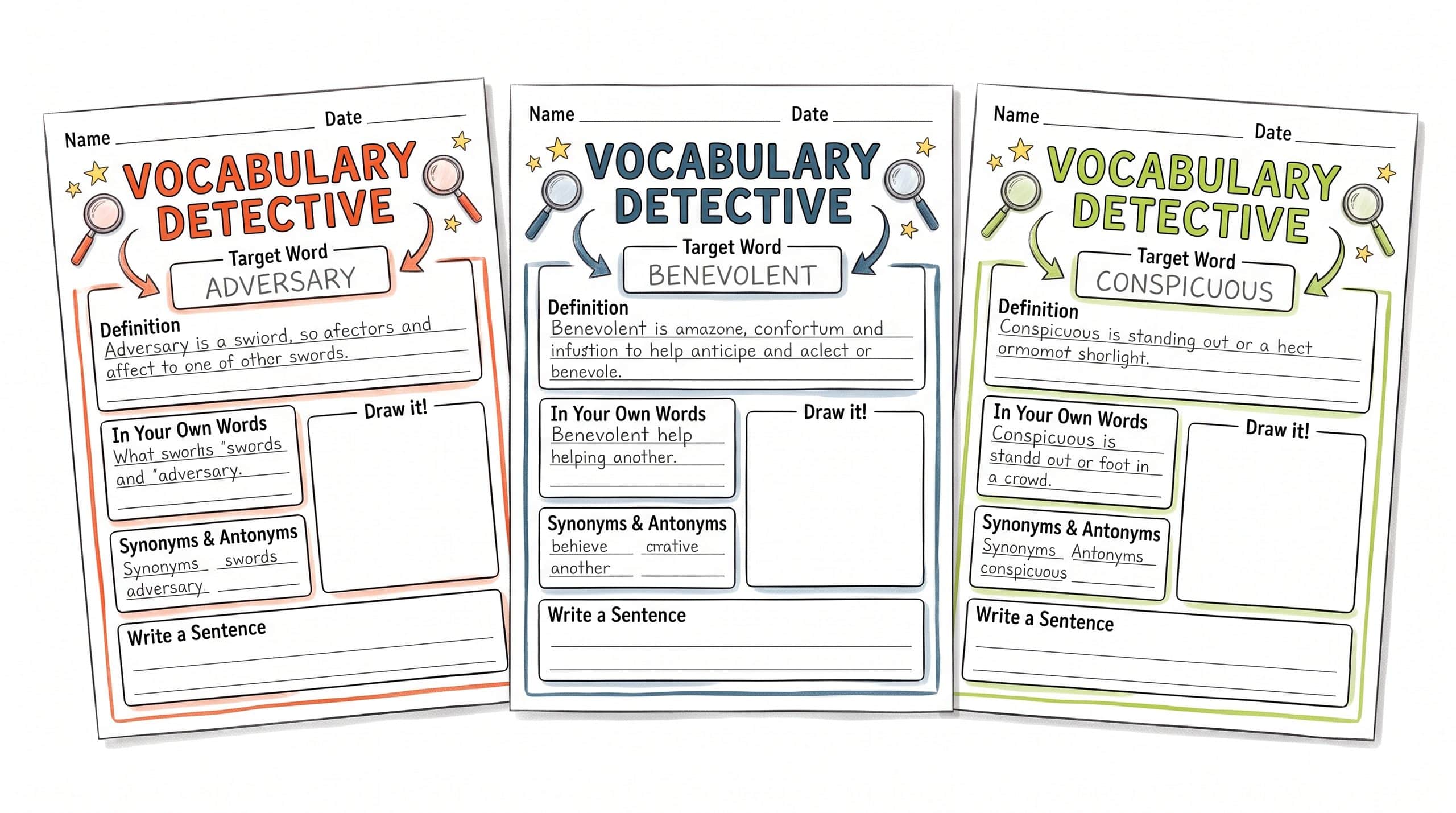
Every Friday, students complete the same vocabulary worksheet with different words. The task and thinking remain the same each time students encounter it.
Repeatable
Same structure. New thinking.
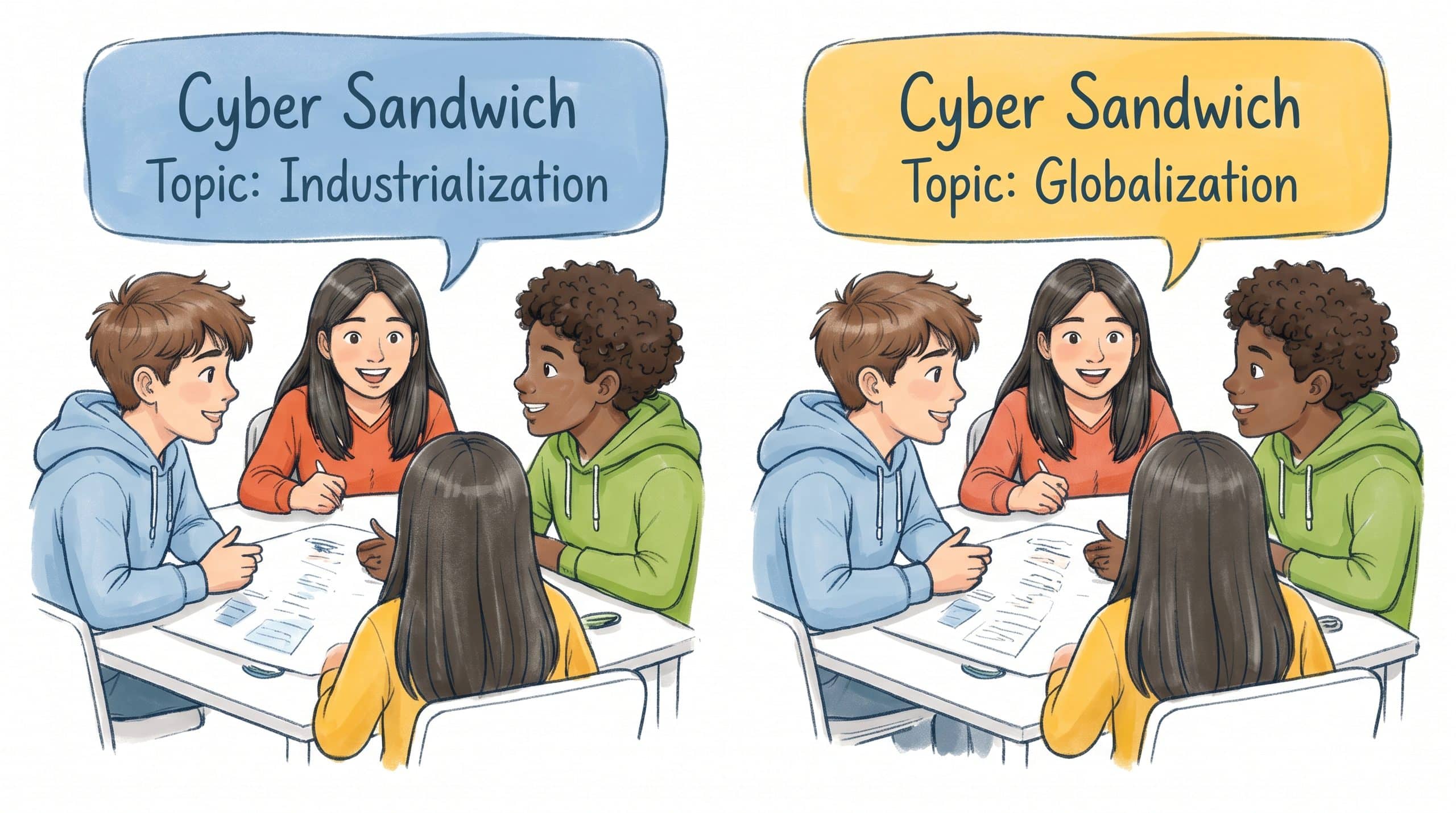
Students regularly use a familiar EduProtocol like Cyber Sandwich, but each time they encounter new content, discuss different ideas, and synthesize new information.
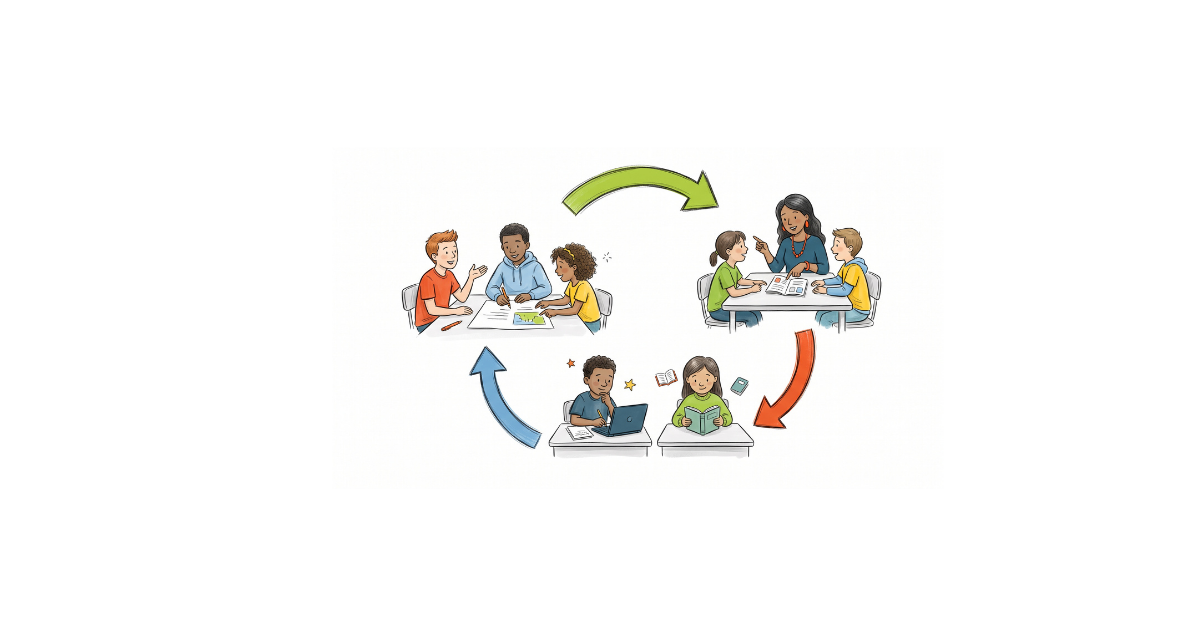
The same principle applies to Station Rotation. The architecture can become familiar without the learning becoming monotonously repetitive. Students recognize the rhythm of teacher-led → online → offline, but what they think about, create, discuss, and produce inside those stations can change dramatically.
Predictability in the process creates flexibility in the learning. That predictability lets teachers and students redirect their cognitive energy to what matters most: learning.
Station Rotation Solves the Architecture Problem
If you’re reading this on Catlin’s website, you probably don’t need me to convince you of the value of the Station Rotation Model. She describes the model as creating smaller learning communities and creating space for differentiated instruction, feedback, collaboration, and agency. Yes, these are things most teachers value, but implementing them sustainably is the challenge.
Differentiation can feel like planning 10 lessons instead of one. Feedback becomes grading everything. Collaboration can feel like controlled chaos. And student agency often bumps up against decades of “we’ve always done it this way.” Countless other educators, Catlin and I included, have wrestled with these real challenges.
Station Rotation provides an architecture that makes differentiation, feedback, collaboration, and agency more manageable. But it doesn’t automatically answer another important question: What will students actually do at a station? That’s where EduProtocols changed everything for me.
EduProtocols Solve the “What Do They Do?” Problem
EduProtocols are student-centered lesson frames that work across subjects and grade levels. The frames stay the same while the content changes. They aren’t curriculum. They aren’t worksheets. They aren’t one-off activities. They’re reusable structures that allow students to focus their cognitive effort on the content and thinking.
Most professions don’t ask people to reinvent their work every day. Doctors use clinical protocols. Pilots use checklists. Lawyers rely on established processes. Professional athletes repeat routines until parts of their craft become almost automatic. Steph Curry doesn’t walk into the gym each morning and ask, “What completely new way should I practice shooting today?”
Yet teaching often operates very differently. Teachers are handed standards, curriculum, student rosters, and told, “Figure out what works for you.” Over time, we can become something resembling pseudo-private contractors: closing our doors, developing our own systems, creating our own activities, and repeating whatever seems to work.
That independence can produce incredible creativity, but it comes at a cost. Teachers spend enormous amounts of time reinventing instructional experiences while students continually learn not only new content, but new directions, workflows, templates, and expectations.
EduProtocols offer another possibility. They don’t eliminate teacher creativity or professional judgment any more than a medical protocol eliminates a doctor’s expertise. They simply provide a reliable starting point. The structure stays familiar, while the content, questions, complexity, and thinking change.
That familiarity doesn’t happen instantly. The first few reps with any EduProtocol will be messy. That’s why teachers should always begin with a Smart Start. Introduce the protocol using fun, low-stakes content so students can focus on learning the structure before wrestling with new academic content.
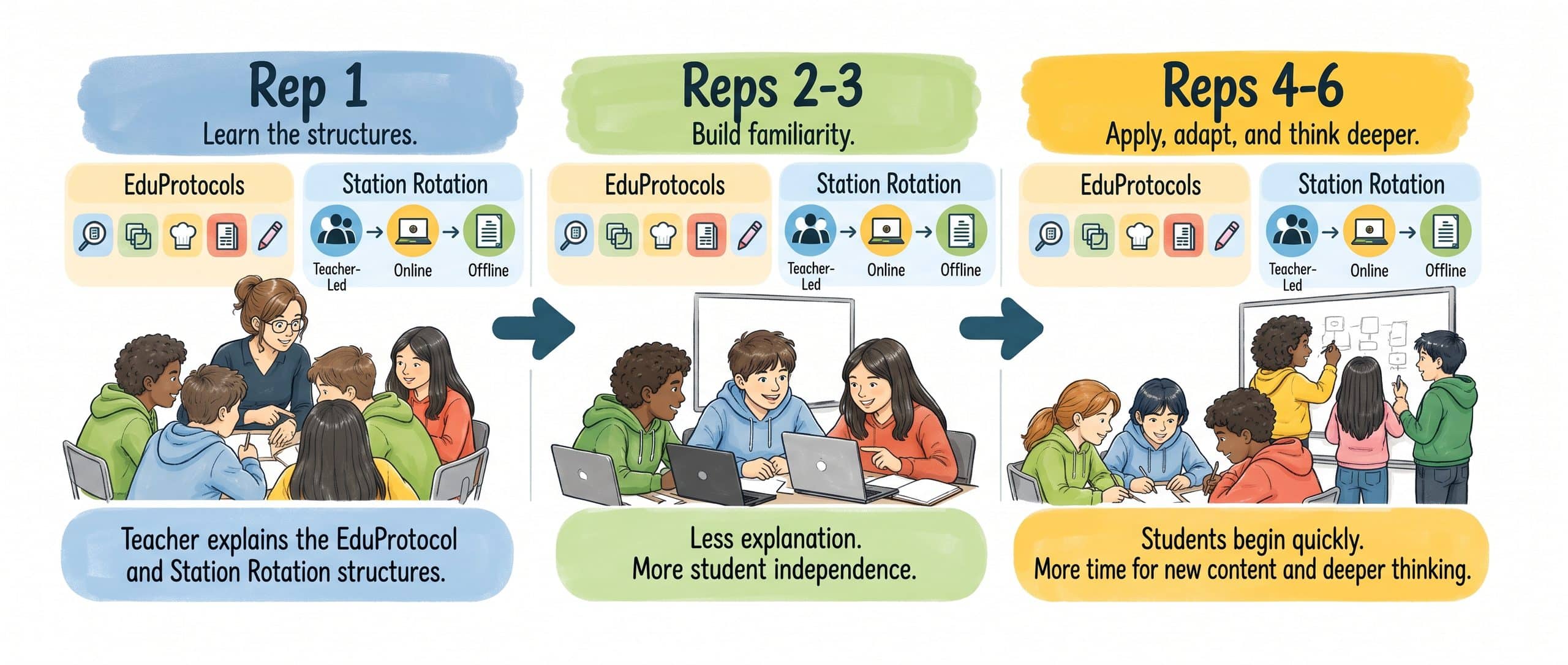
Think of it like coaching a new skill. Introduce it. Practice it. Provide feedback. Repeat it again. After a few rounds, students need fewer directions and begin working more independently. Eventually, “Iron Chef, go!” is enough.
And this is where blending EduProtocols with Station Rotation becomes especially powerful. If I’m working deeply with a small group at my teacher-led station, I can’t simultaneously explain complicated directions to students at the online and offline stations. But if those students already know the instructional structures, I don’t have to. The Station Rotation Model provides the architecture. EduProtocols provide repeatable structures for what students do inside it. The structure becomes predictable so the thinking doesn’t have to be.
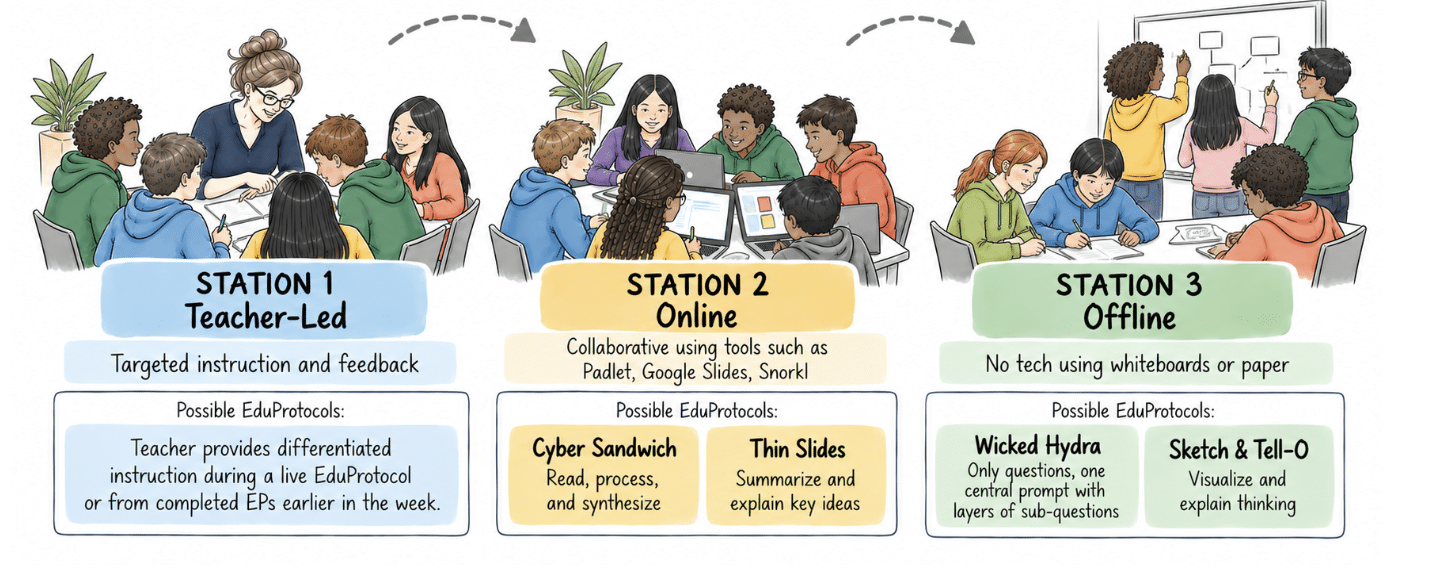
The Teacher Station Becomes More Important, Not Less
When students know what to do at the other stations, the teacher is free to teach. And that doesn’t mean delivering the same mini-lecture three or four times.
The teacher-led station can become the instructional anchor of the rotation: providing targeted feedback, reteaching, questioning, coaching, conferencing, facilitating metacognition, or responding to evidence from previous student work. Teachers might work through an EduProtocol alongside students, provide differentiated support during a live protocol, or revisit an EduProtocol students completed earlier in the week.
Less time explaining directions. More time teaching.
Try This: Start Small
You don’t need to redesign tomorrow’s lesson into a three-station rotation. Start by building familiarity with one EduProtocol.
- Identify the thinking. What do students need to do: retrieve, discuss, explain, synthesize, create, or revise?
- Choose one EduProtocol. New to EduProtocols? Explore the free EduProtocols Sampler for videos, guiding documents, eight ready-to-use templates, and additional resources to help you get started.
- Rep it. Use the same protocol several times with different content until students know the structure and need fewer directions.
- Notice what changes. Are students getting started faster? Are you explaining less? What could you do with the instructional time and cognitive energy you’ve reclaimed?
Don’t build three stations yet. Instead, focus on building student independence first.
From My Classroom to My Current Work
I’m no longer in my own classroom every day, but EduProtocols and Station Rotation continue to shape my work with teachers and preservice educators. The questions are remarkably similar: How do we differentiate, provide feedback, increase student agency, and create more opportunities for students to think without making instruction unsustainable for teachers?
That same challenge is at the heart of the book I’m writing with Catlin Tucker and Jon Corippo. Rather than prescribing lessons or the “perfect” rotation, we’re exploring instructional recipes that combine EduProtocols and Station Rotation in ways teachers can mix, match, and adapt to fit their students, content, and context.
Teachers don’t need 100 more lesson plans. They need a small toolkit of instructional structures they can use 100+ different ways.
In Part 2, we’ll start with the thinking and build from there: choosing the right EduProtocol, designing purposeful stations, and putting it all together without starting from scratch.
No responses yet