
Related Podcast
One of the biggest challenges teachers face when designing a station rotation lesson is shifting from a linear to a circular design. Linear lessons are planned as a progression. Typically, the teacher presents new information, engages the class in shared practice, and releases students to individual practice. In this type of traditional lesson, the flow is straightforward.
By contrast, a rotation is circular. Students begin at different stations and move through the lesson in a circular pattern, hitting the stations in different orders. That means only one group starts at the teacher-led station, so the other stations cannot build on the instruction provided there. That can create barriers for teachers trying to make the shift to effective, differentiated small-group instruction.
In a previous blog, I wrote about a strategy I call “going horizontal with your agenda,” in which teachers take a linear lesson and break it into parts to see whether the individual learning activities could serve as stations with some modifications. This approach works well for many lessons, especially when tasks are more independent.
However, this strategy breaks down when teachers use a gradual release model. If the lesson is designed to move from an “I do” to a “we do” to independent practice, that sequence doesn’t translate easily into a circular rotation. Students can’t apply learning they haven’t yet experienced. This is where the empty station strategy becomes useful. It allows teachers to preserve that instructional flow while designing for the reality of a station rotation.
The Empty Station Strategy
The empty-station strategy is a design move that solves a common challenge teachers face when designing station-rotation lessons. In a traditional rotation, students move through stations in a fixed order. Only one group begins with the teacher. That means some groups are asked to engage in tasks before they have the benefit of instruction.
Instead of designing each station as a fully independent experience, this strategy allows teachers to preserve a more natural instructional flow. To make it work, teachers design one more station than they typically would.
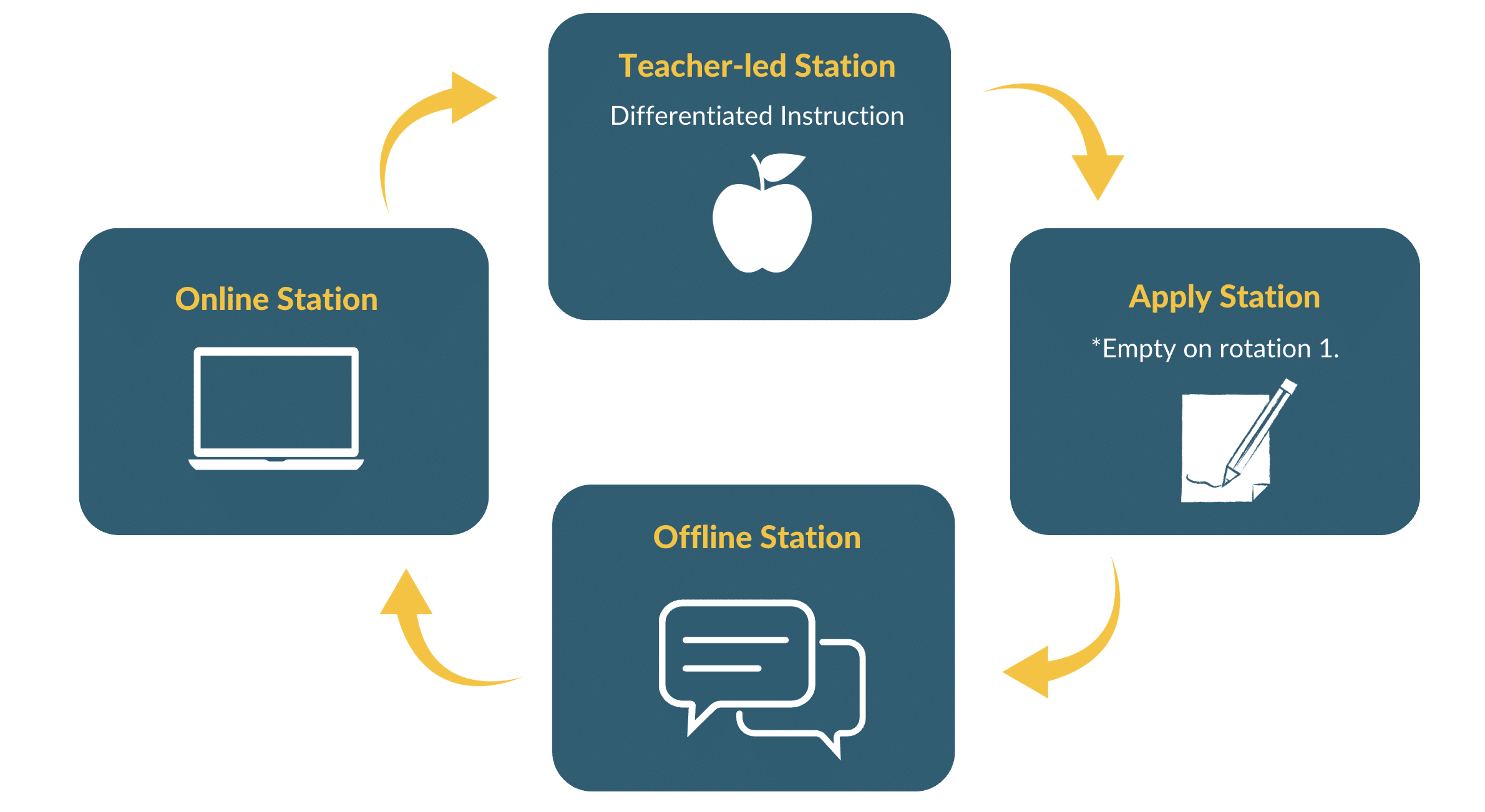
That additional station is intentionally left empty during the first rotation. Following a gradual release model, the “empty” station becomes the application station for the group that begins with the teacher-led instruction. After receiving differentiated instruction, those students move directly to the application station in the next rotation.
This design makes it possible for students to immediately apply what they learned at the teacher-led station.
Elementary Math Example
This strategy is particularly helpful in math and science, where lessons tend to be linear. Let’s take a look at a third-grade math rotation focused on fractions.
The Teacher-led Station
At the teacher-led station, the teacher works with a small group on representing fractions as equal parts of a whole. The lesson follows an I do, we do, pairs do progression. The teacher models how to represent a fraction, guides the group through a second example, and then has students work with a partner to represent a new fraction and explain their thinking.
This is also where teachers can differentiate intentionally. Based on pre-assessment data, groups focus on different aspects of the concept:
- Some students are still working on identifying and modeling fractions.
- Others are ready to represent fractions on a number line.
- Others are extending their thinking by comparing fractions and justifying which is greater.
This allows the teachers to meet the students where they are in terms of readiness and adjust the level of complexity and support in real time.
The Application Station
This station is empty during the first rotation because no students have received instruction yet. When the students leave the teacher-led station, they move to the application station next.
At that station, they complete a tiered application task. One group might identify and model fractions with sentence frames for support. Another group might represent fractions in two ways. A third might compare fractions and justify which is greater. Because this comes after the instruction and guided practice, students are likely to be more confident and better able to explain their reasoning.
The Online Station
The online station does not depend on the teacher-led lesson. Instead, students work in groups of three on a spiral review task using an online math program. Each student solves the problem independently first, then the group discusses their thinking and comes to a consensus before submitting an answer. This structure shifts practice from isolated work to collaborative problem-solving and encourages students to articulate and defend their thinking.
This lesson positions students to build understanding with support and then apply it, while the other stations reinforce skills through collaboration and reflection.
Secondary ELA Example
Now, let’s imagine a secondary English language arts rotation focused on identifying and analyzing themes.
The Teacher-led Station
At the teacher-led station, the teacher works with a small group using a short excerpt. The instruction follows an I do, we do, pairs do progression, with the teacher intentionally modeling thinking and gradually releasing responsibility to learners.
- I do: The teacher models how to identify a theme with a think-aloud that makes the teacher’s cognitive process visible. They project the text, annotate it in real time, highlight key details, and explain how those details point to a central idea.
- We do: The teacher guides students through a second excerpt, prompting them with questions like, “Which details support that idea?” Students in the small group contribute their ideas while the teacher facilitates, clarifies misconceptions, and asks strong questions.
- Pairs do: Students work in pairs to read a new passage, identify a theme, and select supporting evidence. The texts can vary in complexity to challenge students at different levels of readiness. The teacher listens, observes, and works with students who need additional support and scaffolding.
Differentiation:
- Some groups use sentence frames to support writing theme statements.
- Others focus on tracing how a theme develops across a passage.
- Others analyze how literary elements contribute to the theme.
The Application Station
The apply station is intentionally empty during the first rotation. After working with the teacher, students move here next. Students will apply their learning by:
- Reading an excerpt and writing a theme statement.
- Selecting 2-3 pieces of textual evidence.
- Explaining how the evidence supports and develops the theme.
Tasks can be tiered based on the group’s level of readiness. Some students use scaffolds and others engage in deeper analysis.
Online Station
This station is independent of the teacher-led instruction and asks students to actively engage with digital text using the reciprocal teaching protocol. Students work in a small group to read and make meaning together.
Each member of the group has a specific role that guides their reading and contributions to the conversation.
- Predictor: Looks for clues in the texts and makes predictions.
- Clarifier: Identifies words, phrases, ideas, or references in the texts that are confusing or unclear so the group can make sense of them.
- Questioner: Asks questions about the text to engage the group in conversation and deepen their understanding.
- Summarizer: Summarizes the key ideas in the text to provide an overview of the most important information in that section.
Students can retain the same role throughout or rotate roles each time they pause for a discussion.
The Offline Station
This station is designed to deepen analytical thinking. Students complete a claim-evidence-question task with a text they read in a previous class. For example, students can read a text and choose one of the following thinking routines to complete. Fast finishers can do both, or you can provide another pathway to keep them productively engaged.
Character Development
- Claim: How does the character change or respond to a challenge?
- Evidence: What details show this?
- Question: What are you still wondering about this character?
Impact of Setting
- Claim: How does the setting influence what happens in the text?
- Evidence: What details describe the setting and its impact?
- Question: What questions do you have about how the setting shapes the story?
This design keeps the focus of each station clear, allowing students to engage in supported analysis, inclusive reading comprehension, and independent thinking.
Wrap Up
The station rotation model asks teachers to rethink their approach to lesson design. Planning for a circular model instead of a linear progression can feel challenging at first, especially when teachers are trying to preserve a gradual release of responsibility or working with an adopted curriculum.
The empty station strategy makes that shift more manageable. It allows teachers to maintain a clear instructional sequence while designing for a rotation where students begin in different places.
The payoff is worth it. This approach creates more opportunities for differentiated instruction, more time for meaningful teacher-student interaction, and more responsive support for increasingly diverse groups of learners.
For more on the station rotation model, check out my book, The Station Rotation Model and UDL: Elevate Tier I Instruction and Cultivate Learner Agency.
No responses yet