
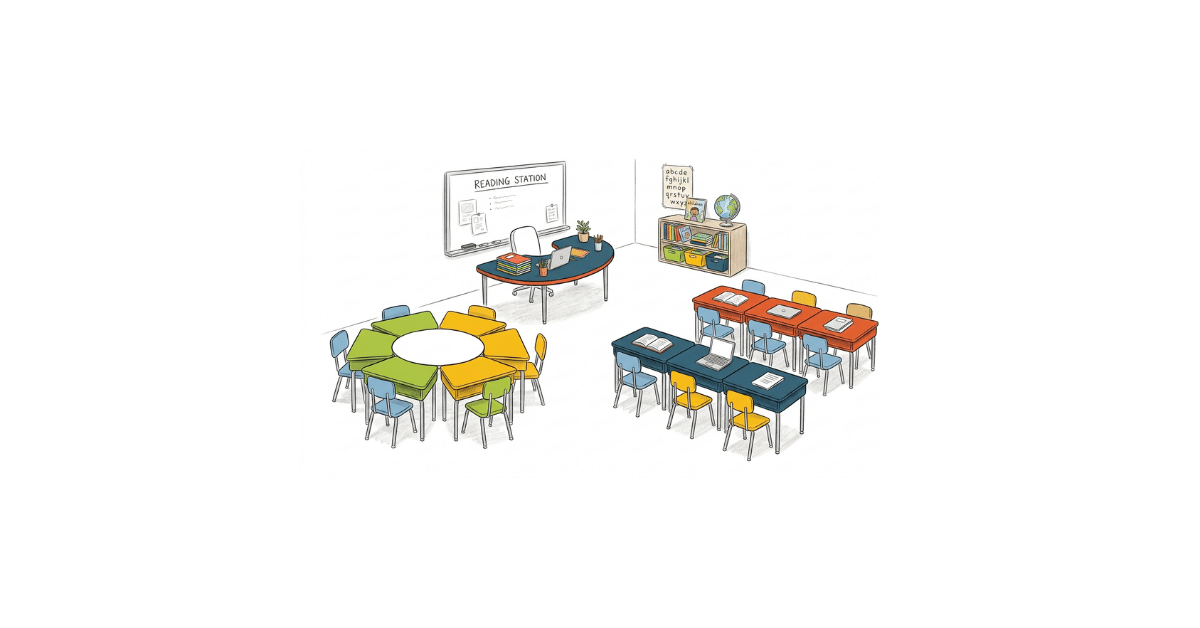
In my previous post, UDL and the Station Rotation Model in the Early Grades: Why Routines Must Come Before Content, I wrote about the importance of setting the stage for successful implementation with clear routines. Routines create the structure students need to become increasingly independent learners.
Routines on their own are not enough. If the teacher is the only source of directions, reminders, and support in a classroom, students will remain dependent on the teacher. This can make transitioning to the Station Rotation Model challenging. In a rotation, teachers are facilitating their teacher-led station, differentiating instruction and modeling sessions for small groups, and need to concentrate on the small group in front of them. That means the learning environment should shoulder some of the instructional load. While the teacher is providing targeted instruction, the classroom should help students navigate tasks, troubleshoot simple issues, and access the supports they need to continue learning independently.
This post explores how intentionally designing the learning environment can remove barriers and support growing independence for even our youngest learners. From a UDL perspective, the learning environment is another tool we can intentionally design to remove barriers that might interfer with learning. The goal is to design a classroom that answers students’ questions before they need to ask the teacher. Students should be able to find what they need, solve simple problems, and move through the learning without needing the teacher at every turn.
When we thoughtfully design our classrooms with designated zones, visual supports, clear signage, intentional furniture arrangements, and accessible resources, the classroom itself becomes another teacher. The space can support students while freeing the teacher to provide targeted small-group instruction and respond to learners’ individual needs.
Create Designated Learning Zones
One of the most consistently supported strategies in the research on flexible learning environments is the use of classroom zones or micro-environments, designed to support different types of learning activities. Rather than treating the classroom as a single instructional space, zoning allows teachers to intentionally design areas that communicate the purpose of the learning taking place there. Classroom zones are particularly helpful for young learners who rely heavily on environmental cues to understand what behavior and activity are expected in a given space (Kale & Kawane, 2026).
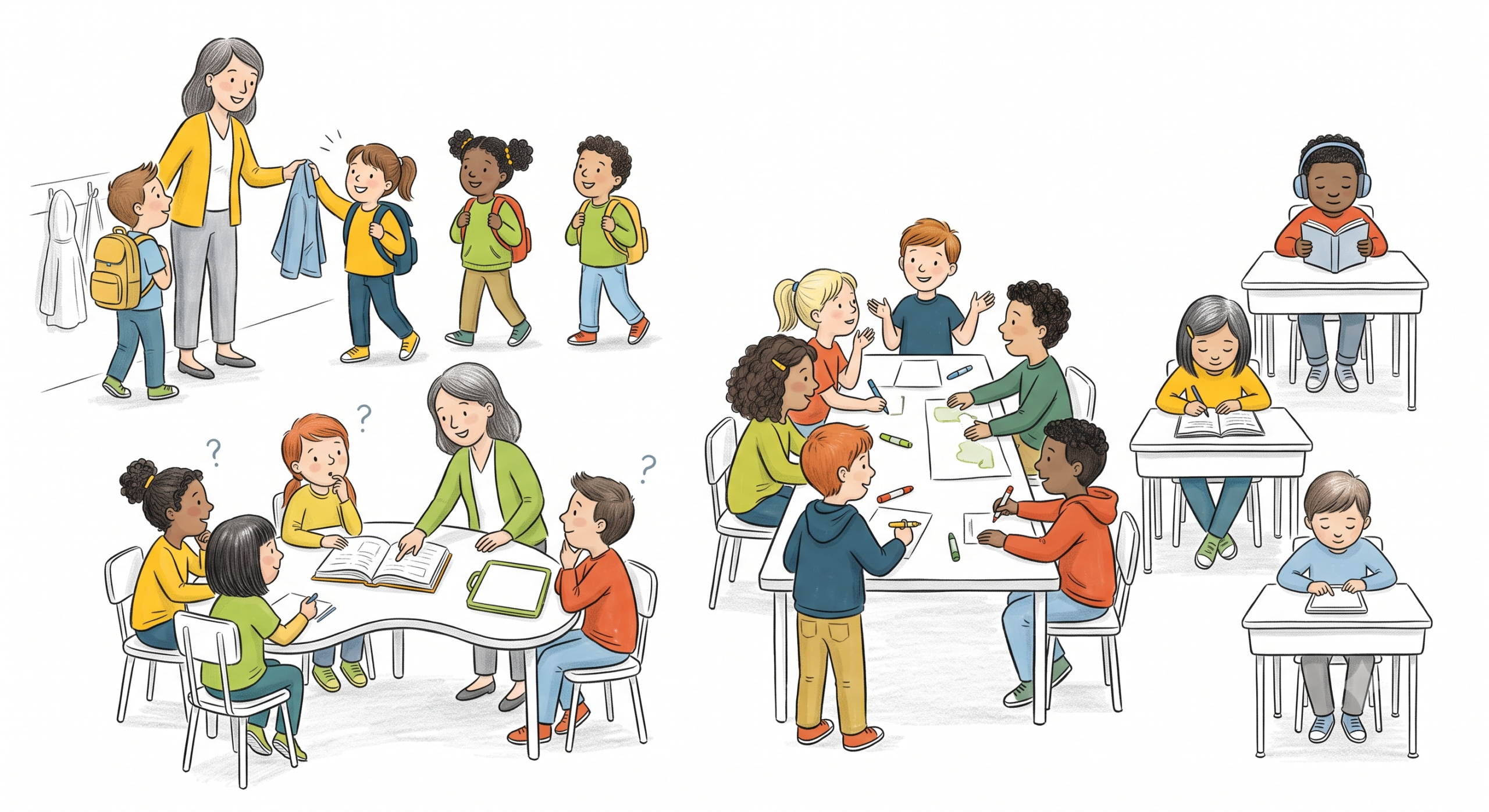
From a UDL perspective, these zones remove unnecessary barriers by making the classroom more predictable and easier to navigate. Instead of relying on the teacher for constant direction, students begin to use the environment as a guide for what to do and how to do it.
When designing classroom zones, every area should answer these three questions.
- What happens here? What type of learning occurs in this space?
- What tools are available here? What materials or resources support the learning?
- How should students behave here? What should the learning look and sound like in this space?
If students can answer those three questions simply by looking around the room, then the environment is doing some of the instructional work for you. Below are several types of zones you might want to consider creating in your classroom.
| Zone | Purpose | Possible Features |
| Welcome Zone | Help students transition to learning and begin independently | Turn-in basket Daily agenda Welcome activity Materials to collect Absence work folder Visual schedule |
| Small-Group Instruction Zone | Space for targeted instruction, conferencing, and assessment | Teacher table Manipulatives Whiteboard Dry-erase boards Guided reading materials Math manipulatives and tools |
| Collaboration Zone | Encourages discussion, problem solving, and shared creation | Tables Chart paper Maker materials Discussions Get stems Collaborative task cards |
| Independent Learning Zone | Supports focused, self-directed work | Comfortable seating Independent reading Reflective journals Quiet tasks Brain break activities Visual timers |
| Technology Zone | Supports digital learning and responsible device use | Charging station Headphones Tablets and laptops QR codes with directions Internet safety tips Login cards |
| Learning Support Zone | Give students access to tools that remove barriers without having to ask the teacher | Pencils Paper Number lines Alphabet strips Manipulatives Sentence stems Graphic organizers Dictionaries Timers Sensory tools |
Teachers do not need to create every single one of these zones. Instead, think about the moments during the day when students rely most heavily on you. Do they consistently ask where to turn in work? Do they ask where to find materials? What to do when they finish? Those questions will reveal opportunities for us to redesign the environment so it provides that guidance and support instead.
Supporting Student Thinking with Visual Supports
One way to reduce the cognitive load for young learners is to make thinking visible. Instead of expecting students to remember directions, steps in a process, or strategies, use visual supports that allow them to access that information independently when they need it.
Young learners have limited working memory. If they are trying to remember the teacher’s directions while also simultaneously completing a task, collaborating with peers, or solving a problem, their cognitive resources can become overwhelmed. Visual supports reduce that burden by making important information continuously available instead of interrupting the teacher to ask, “What do I do next?” or “How do I solve this?” Students can use resources around them to answer those questions independently.
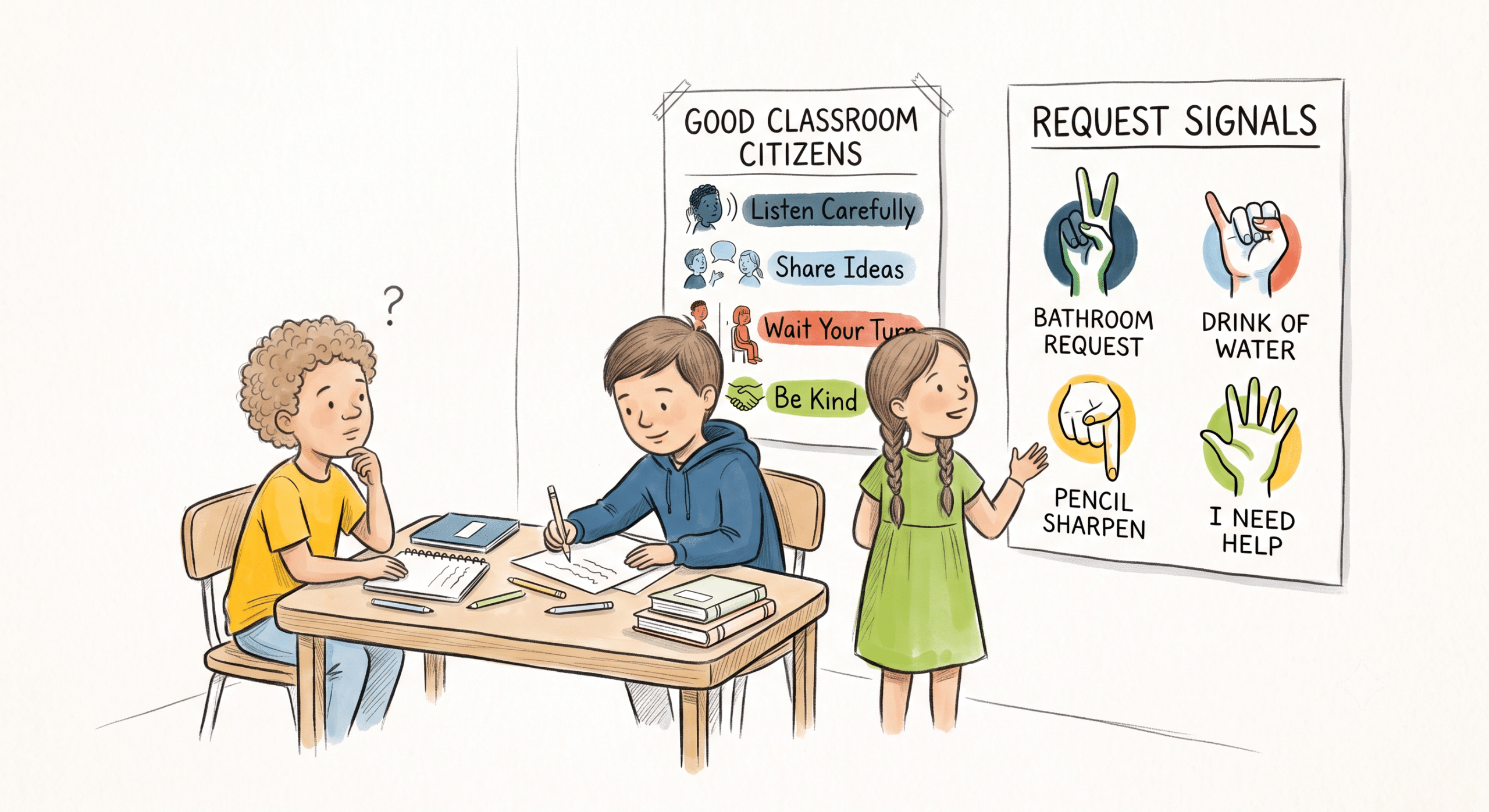
From a UDL perspective, visual supports proactively remove barriers by providing multiple ways for students to access information and guidance. They also reinforce a really important message, which is that the classroom is full of resources that are designed to support thinking. Some of the most effective visual supports include:
- Anchor charts that capture strategies, processes, or examples that students can reference during the learning.
- Visual workflows using pictures, icons, and simple checklists that break multi-step tasks into manageable parts.
- Sentence stems that support collaborative conversations and academic discourse.
- Worked examples that show students what quality work looks like before they begin.
- Picture directions that allow emerging readers to navigate tasks without relying solely on written instruction.
- Content-specific reference tools such as number lines, hundreds charts, alphabet strips, sound walls, vocabulary cards, or graphic organizers.
It is important to note that we do not want to cover every inch of every wall with visuals. The research indicates that 20-50% of wall space should be kept clear to maintain focus and attention (Fisher, Godwin, Seltman, 2014). Too many visuals can be another source of distraction and cognitive overload. Instead, display the supports students actually need. Then teach them how to use those supports and regularly reference them during instruction. The more students see you using an anchor chart, pointing to a visual flow chart or workflow, or modeling how to use a reference tool in the classroom, the more likely they are to use those resources independently during a station rotation.
Arrange Furniture to Support Learning
The way we arrange furniture communicates what kind of learning we expect students to do in a particular space. Just as classroom zones signal the purpose of an area, the furniture within each zone should reinforce how students will learn there. In other words, the physical environment should communicate the expectations before the teacher ever has to explain them.
For example:
- A small table with four or five chairs around it naturally communicates conversation and collaboration.
- A quiet corner with soft seating encourages reading, reflection, and independent work.
- Open floor space with clipboards and whiteboards invites movement and hands-on learning.
- A maker space stocked with materials encourages creativity, tinkering, exploration, and problem-solving.
In each case, the furniture is sending students a very clear message about what learning looks like in that space.
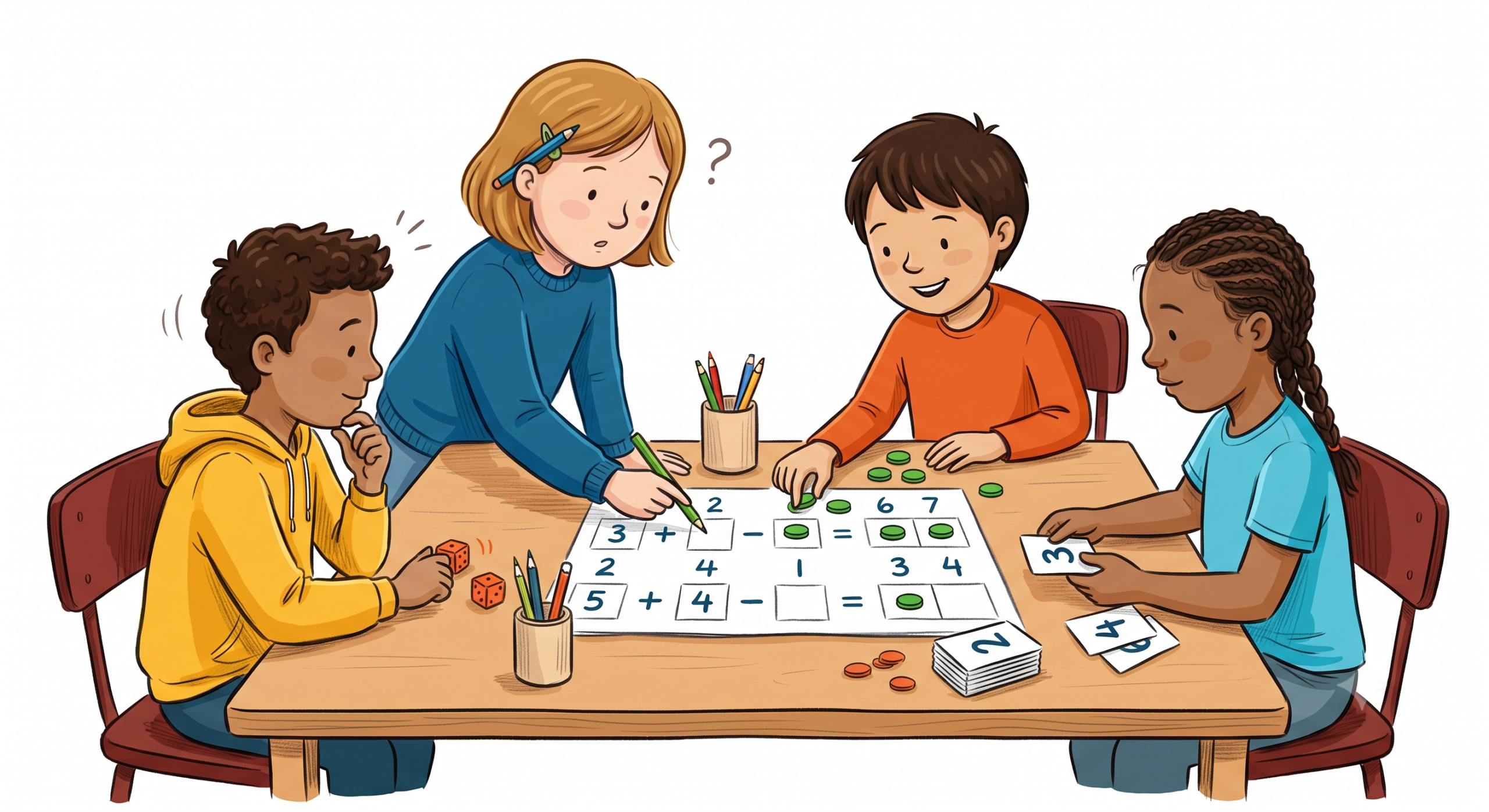
From a UDL perspective, intentionally arranging furniture removes unnecessary barriers by making it easier for students to move between different learning experiences and participate in ways that align with the task and the teacher’s expectations. It also reduces transition time because students don’t have to rearrange desks. As you think about your classroom, ask yourself:
- Does the furniture support the type of learning happening in each zone?
- Can students easily transition between learning experiences?
- Is there enough flexibility to accommodate independent work, partner learning, collaboration, and student-led instruction throughout the day?
- Does the arrangement encourage movement without creating unnecessary distractions?
Remember, flexibility doesn’t necessarily mean we have to have flexible furniture. Even in classrooms with traditional desks and tables, teachers can thoughtfully arrange existing furniture to create distinct learning spaces that support different instructional goals.
The objective is intentionally designing a classroom where furniture helps communicate expectations, supports learning, and allows students to navigate the day with increasing confidence and independence.
Make Learning Supports Easy to Find and Use
One of the simplest ways to build independence for young learners is to make sure the tools they need are readily available. Too often, students interrupt the teacher because they can’t find a pencil, they need another piece of paper, forgot where the math manipulatives are stored, or they aren’t sure where to find supports like a graphic organizer or a number line. While each interruption might seem minor in the moment, it pulls the teacher’s attention away from small-group instruction happening at the teacher-led station.
Instead, think about creating a learning support station or a learning support zone where students know they can independently access the materials and tools they need to continue learning. From a UDL perspective, this is another way we proactively remove barriers before they interrupt learning. Instead of waiting for students to ask for help, we design the environment so many of their needs can be met independently. Depending on your students and the learning taking place, your learning support station or zone might include items like:
- Sharpened pencils, crayons, scissors, glue, paper, headphones or earbuds for listening activities
- Number lines, hundreds charts, multiplication tape charts, and other math reference tools
- Alphabet strips, sound walls, vocabulary cards, or high-frequency word lists
- Graphic organizers and writing templates
- Manipulatives for math or science investigations
- Timers to help students manage their work time
- Fidgets or other regulation tools, if they’re part of your classroom routines
The goal isn’t to fill a shelf with supplies. The goal is to teach students that these resources exist to support their learning and that they are expected to use them when they need them and put them back when they are done. That expectation is important. Many young learners will continue asking the teacher for help simply because it’s a habit they’ve developed. We have to intentionally teach students to pause before they ask the teacher and instead ask themselves:
- Is there a tool in the classroom that can help me?
- Can I use one of the visual supports we’ve created?
- Can I solve this problem with the resources available to me?
Over time, students begin to see the classroom as a resource-rich learning environment instead of viewing the teacher as the only source of support. That shift is a really important step toward growing independent and self-directed learners.
As you look around your classroom, ask yourself:
- If I were working with a small group, could my students find what they need without interrupting me?
- Are the learning supports students use most often visible and accessible?
- Have I explicitly taught students when and how to use those supports?
- Does my classroom encourage students to rely on the environment before relying on me?
Simply making resources available isn’t enough. Just like routines, students need to be taught where the supports are, when to use them, and how to use those tools. When we intentionally design classroom zones, make thinking visible with visual supports, arrange furniture to support learning, and provide accessible resources, we’re designing an environment that removes barriers, reduces cognitive load, and helps students develop the confidence to navigate the learning with increasing independence.
Want To Learn More?
Check out The Station Rotation Model & UDL: Elevate Tier 1 Instruction & Cultivate Learner Agency!
5 Responses
Love this!!!
Hi Ruba!
So glad this is useful. Hope you are well.
Best,
Catlin
Thanks for this useful fo. I teach adults at university in a blended environment. The zones are useful to introduce the diverse spaces used in and for teaching and learning. I
Thanks
You’re welcome, Barbara! I am glad this was useful!
Best,
Catlin
I really like the idea of designing the classroom so students can find what they need without always relying on the teacher. Clear learning zones and visual supports seem like simple ways to encourage more independence from an early age.