
Related Podcast Episode
Reading comprehension affects almost every aspect of a student’s work in school. When students struggle to make sense of what they read, the impact extends far beyond their English class. They may struggle to understand complex math word problems, make sense of informational texts in history, follow multi-step procedures in science, and independently navigate written instructions.
For teachers, those gaps in reading comprehension can make it challenging to meet the range of needs in a classroom. Some students may be ready to analyze, discuss, and apply what they have read. Others are still working to identify key ideas, make connections, or recognize when they do not understand the text.
Unfortunately, national reading data suggest these challenges are becoming more pronounced. The 2024 National Assessment of Educational Progress (NAEP) showed continued declines in reading performance. 40% of fourth graders perform below the NAEP Basic level. The average reading scores declined for both fourth- and eighth-grade students.
Balancing Whole-Group and Small-Group Explicit Instruction
The growing national focus on the science of reading reflects the urgency around helping students become proficient readers. Developing strong foundational reading skills is a critical aspect of this work. Explicit instruction is a critical part of that work. Students benefit when teachers clearly explain and model literacy skills and provide structured opportunities to practice with support.
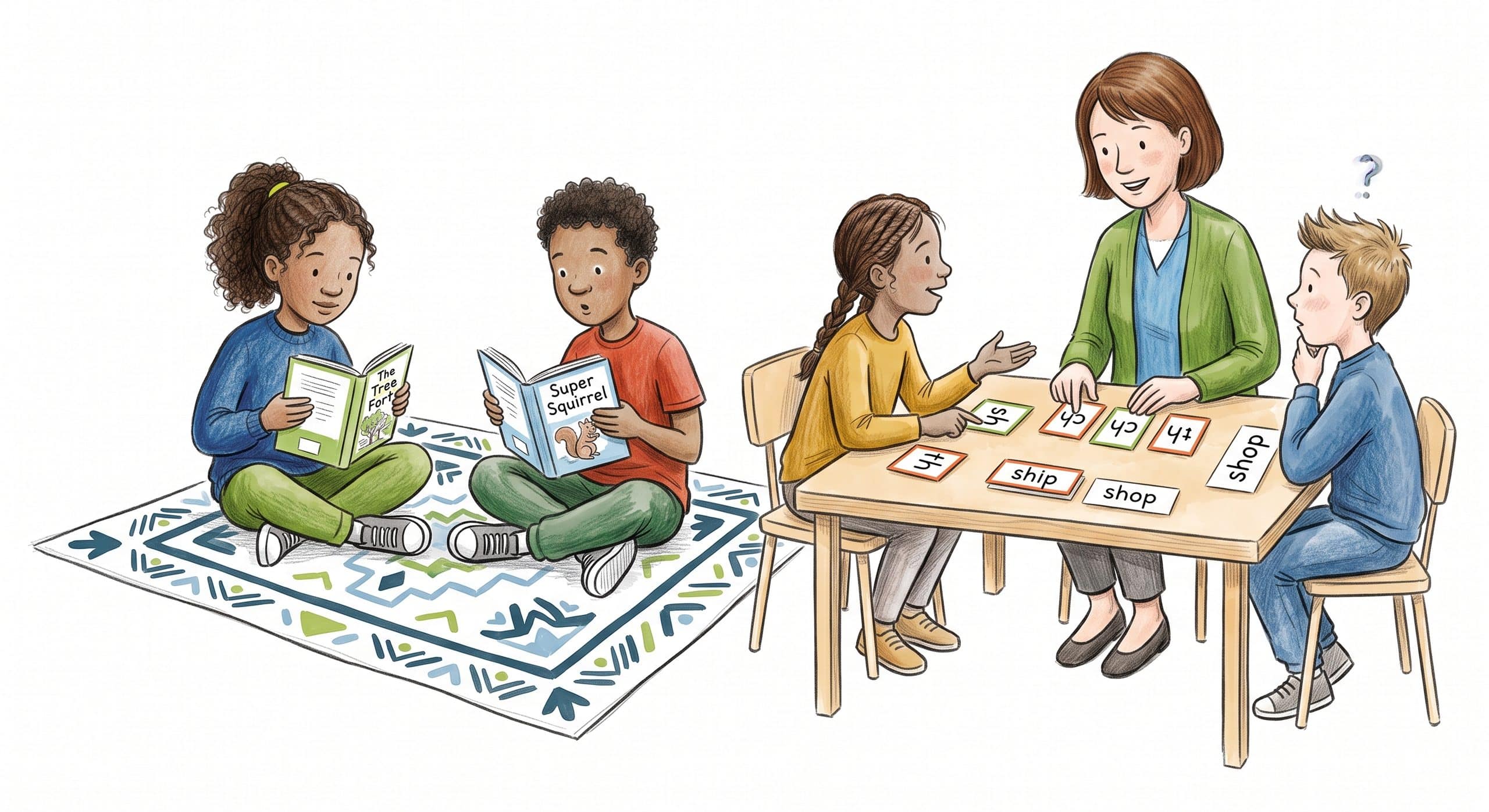
Most classrooms include students with a wide range of reading skills. As a result, explicit instruction does not always need to look the same for every student. Balancing whole-group instruction with differentiated small-group instruction allows teachers to be more responsive to students’ specific needs. In small groups, teachers can adjust the content, level of explicit instruction, scaffolding, and the intensity of instruction based on what students need to make progress (Siegal, Hall, & Mesa, 2024). Research supports this differentiated approach. Studies have found positive effects when students are grouped according to their academic needs. Differentiating literacy instruction for those groups can further improve student learning. In fact, students in classrooms where teachers differentiate their small-group instruction have outperformed students in classrooms where teachers use small groups but deliver the same instruction to every group.
Creating Opportunities For Students to Apply Literacy Skills
Explicit instruction, whether it happens whole-group or in small-group, is only part of the literacy landscape. Students also need opportunities to work with the text and apply the skills and strategies they are learning independently. They need time to practice identifying important ideas, asking questions, looking for clues to draw conclusions, and recognizing when they do not understand a text. Ultimately, we want students to be able to do this work with increasing confidence and independence.
Research also suggests that students benefit from a combination of teacher-led instruction and opportunities to practice new skills with peers or independently. Finding the right balance between these learning experiences is important. We want to provide explicit instruction and differentiated support that students need when learning key literacy skills. At the same time, we also need to create opportunities for them to take more responsibility for making meaning on their own and in collaboration with their classmates. Reciprocal teaching offers a powerful structure for doing that in classrooms (Siegal, Hall, & Mesa, 2024).
Reciprocal Teaching: A Structure for Collaborative Meaning-Making
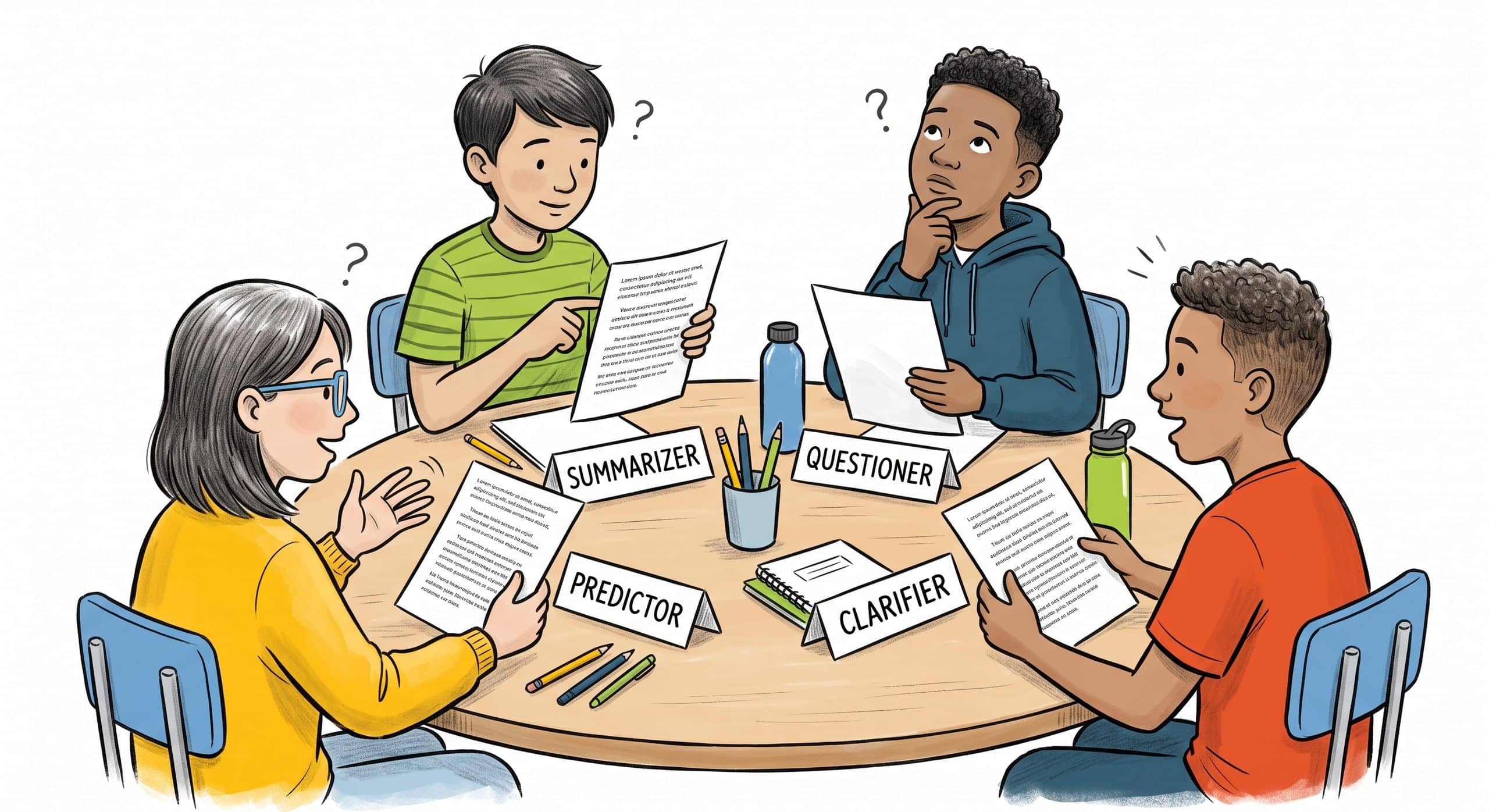
Annemarie Palincsar and Ann Brown developed reciprocal teaching, which is an inclusive, collaborative, multimedia meaning-making strategy. It engages students in using four comprehension strategies to make sense of a text: predicting, summarizing, questioning, and clarifying.
What makes reciprocal teaching particularly powerful is the combination of explicit instruction paired with active practice. Students are taught the comprehension strategies they need, but they’re also given structured opportunities to apply those strategies as they read, discuss, and make meaning with their peers.
The research supporting reciprocal teaching stretches back more than four decades. In their foundational study, Palinscar and Brown (1984) found that seventh-grade students who struggle with comprehension made significant gains. They were also able to maintain those gains over time and transfer their learning to new comprehension tasks.
A decade later, Rosenshine and Meister (1994) reviewed 16 studies of reciprocal teaching. They found positive effects on reading comprehension. Importantly, their review found stronger effects when students received explicit instruction in comprehension strategies before engaging in reciprocal teaching.
Explicit Instruction Is Essential to Student-Led Learning
That finding reinforces a really important point: student-led does not mean the teacher is absent. If we want students to independently summarize what they have read and ask questions that deepen their understanding, we need to teach them how to do those things first. Then, we need to create opportunities for them to practice using those skills with support and feedback before expecting them to navigate the routine independently. That’s where onboarding becomes critical.
Reciprocal teaching has continued to appear in larger research syntheses. Hattie (2009) reported an overall effect size of 0.74 for reciprocal teaching, adding to the substantial body of research supporting its potential to positively impact student learning.
Onboarding Students to Reciprocal Teaching
Reciprocal teaching asks students to apply several skills simultaneously. They need to understand their individual comprehension lens, apply it effectively to a text, communicate their thinking, listen actively to their peers, and engage in discussion, building on one another’s ideas. There are a lot of moving parts, especially when students are first learning the routine.
That’s why investing the time and energy on the front end is so important. If we want students to eventually navigate reciprocal teaching with confidence, independently in small groups, we need to:
- explicitly teach the skills
- model the process
- provide opportunities for supported practice
- give students feedback as they develop those skills
In my previous post, “Onboarding Students to Student-Led Learning Strategies,” I shared a five-step process for gradually releasing responsibility for student-led routines. That same process can be used to onboard students to reciprocal teaching. The upfront investment, though not insignificant, allows students to eventually manage this powerful literacy routine with less teacher direction, creating more opportunities for them to actively make meaning with their peers.
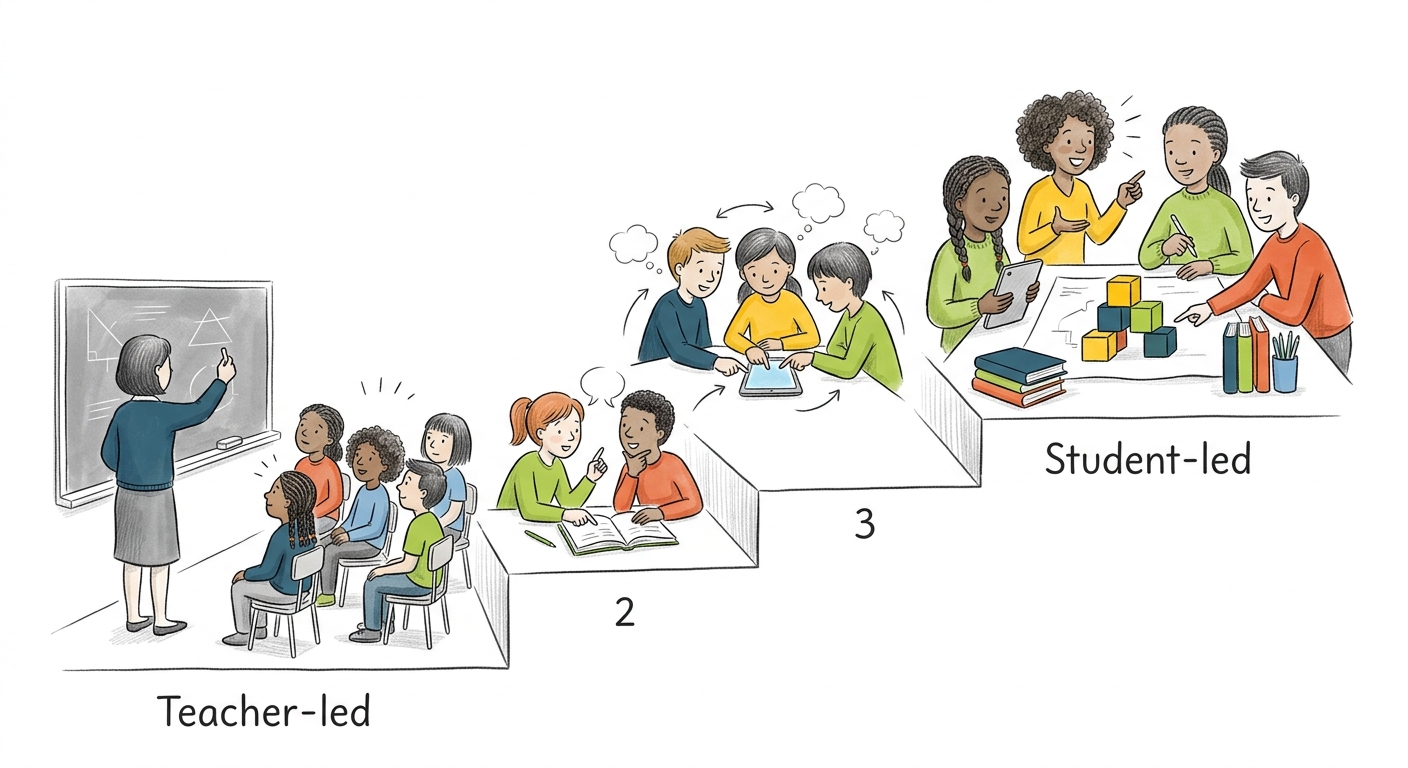
Let’s look at what each step of the onboarding process might look like with reciprocal teaching.
I Do: Explicitly Teach Each Comprehension Lens
Before asking students to use reciprocal teaching in small groups, teachers should explicitly teach each comprehension lens and model the thinking involved.
- For summarizing, teachers can model how to identify the most important information and key ideas while reading. A think-aloud can make visible how they determine what is essential, distinguish key ideas from supporting ideas, and decide what information is not worth prioritizing. Students need to understand that summarizing requires them to determine what matters most and communicate those ideas clearly and concisely.
- For questioning, teachers can model the difference between questions with easy-to-find answers and those that invite deeper thinking or discussion. Language like “on-the-surface questions” and “below-the-surface questions” can make this distinction easier for students to understand and remember. Question stems can also help students move beyond simple recall questions to generating questions that encourage their peers to analyze, make connections, and consider the implications of details in a text.
- For clarifying, Teachers can model how to pause when they encounter an unfamiliar word, confusing phrase, unfamiliar reference, or challenging concept. A think-aloud can make the internal process visible: What exactly is unclear here? What information or strategy could help me make sense of this? Students need to learn that strong readers don’t simply continue when they are confused. They notice their confusion, identify what is unclear or unfamiliar, and take steps to resolve it.
- For predicting, Teachers can model how to use evidence and clues from the text, along with what they have already read or learned, to anticipate what might come next. Sentence stems such as “Based on _____, I predict _____ because _____” can reinforce that a strong prediction is not a guess; it is grounded in evidence from the text and prior learning.
We Do: Practice Together with Teacher Support
After explicitly teaching and modeling the four reciprocal teaching comprehension lenses (summarize, question, clarify, and predict), teachers can give students opportunities to practice each one with support before asking them to coordinate all four in a small group.
- For summarizing, Teachers might share a small section of text and ask students to identify two or three ideas they believe are most important. Students can first jot down their ideas independently, compare their thinking with a partner, and then work with the class to construct a concise summary. As students share their thinking, the teacher can ask questions like:
- Is this idea essential to understanding the section?
- Is this a key idea or a supporting detail?
- Could we leave it out without losing the meaning of this section of the text?
- For questioning, students might generate one or two questions about the next section of text using the question stems introduced during the “I do.” They can compare their questions with a partner and consider which are more likely to generate an interesting discussion or deepen understanding of the text. The teacher can highlight examples that move beyond recall and ask students what makes those questions particularly effective. This reinforces the distinction between on-the-surface and below-the-surface questions.
- For clarifying, teachers might ask students to identify a word, phrase, reference, or idea in a text that causes confusion. Instead of immediately explaining it, the teacher can ask a question like: What could we do to clarify this or make sense of it?” Students might reread the surrounding text, look for and use context clues, break apart an unfamiliar word, or talk with a partner. This helps them practice not only recognizing moments when their comprehension is breaking down but also selecting a strategy to resolve the confusion.
- For predicting, students can use clues and evidence in the text, along with what they have already read, to make a prediction and explain the thinking that informed it. A scaffold such as “Based on ____, I predict ____ because ____” can help students connect their predictions to evidence rather than simply guessing. Sharing and comparing predictions also reinforces that there may be multiple reasonable predictions when they are supported by evidence.
Fishbowl: Observe, Analyze, and Refine
The fishbowl strategy gives students an opportunity to see how the four comprehension lenses work together before they are expected to independently navigate reciprocal teaching in small groups. To prepare for the fishbowl, the teacher should select a text that is accessible to the class and divide it into short sections. This makes it possible to move through repeated rounds of reading, discussion, feedback, and adjustment.
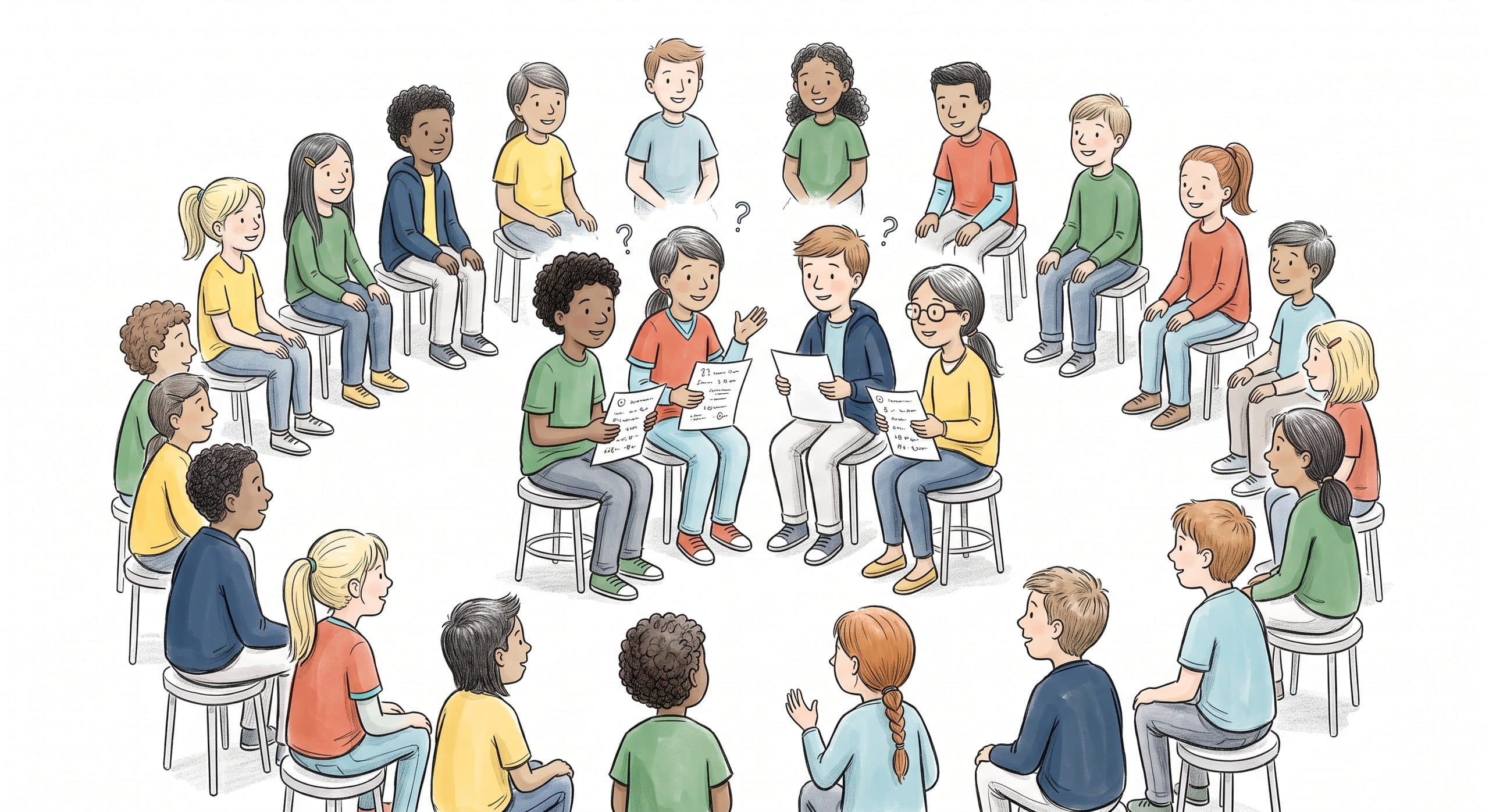
The Inner Circle Practices the Strategy
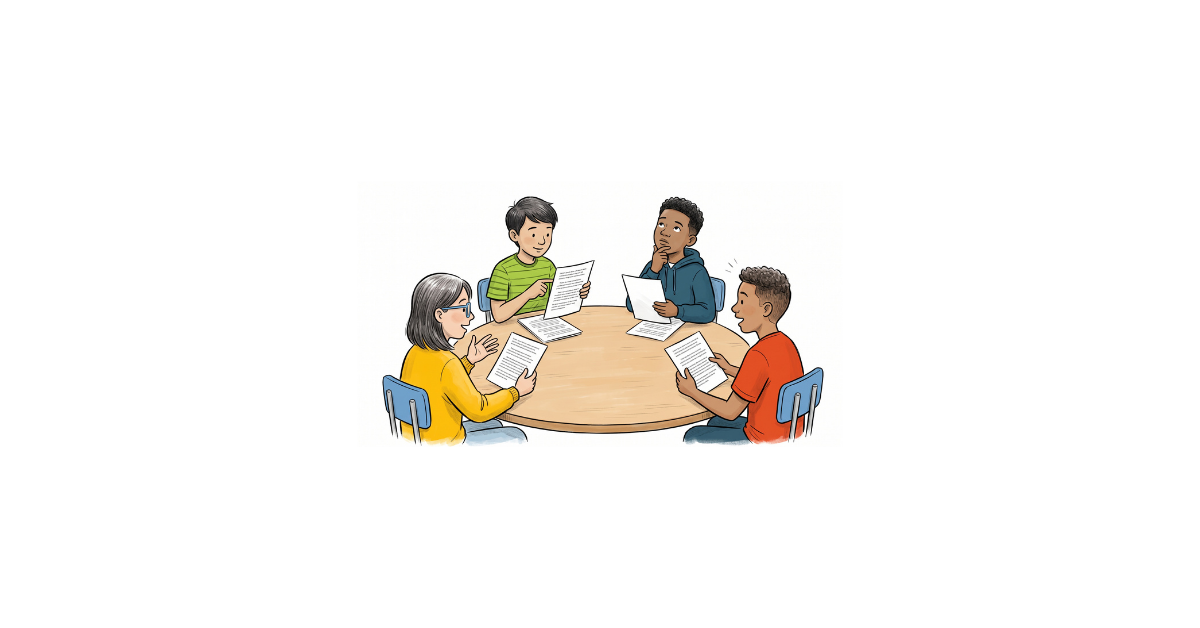
Teachers can select four students who are comfortable speaking in front of the class and position them in a circle at the center of the classroom where the other students (or outer fishbowl) can see them. Each of the four students in the inner fishbowl is responsible for one of the four reciprocal teaching comprehension lenses.
- Summarize
- Question
- Clarify
- Predict
The rest of the class sits around them in an outer circle and observes. Students read the first section of text, then the four students in the inner circle discuss what they read using their assigned comprehension lenses.
- The summarizer identifies and communicates the most important ideas.
- The questioner poses a “below-the-surface” question designed to deepen the group’s thinking about what they saw.
- The clarifier surfaces a word, phrase, reference, or idea that may need further explanation.
- The predictor uses evidence from the text to anticipate what might happen next.
The Outer Circle Provides Feedback
After the discussion, the teacher pauses the inner circle and offers specific feedback. The goal is to reinforce what students did effectively and identify two or three moves to focus on in the next round. The teacher might comment on the quality of the question, the evidence used to support a prediction, or how effectively students built on one another’s ideas.
The teacher then invites the outer circle to provide feedback. Students can identify what the inner circle did that helped the conversation move smoothly and productively. What did they hear that they might want to replicate when it’s their turn? What suggestions do they have for strengthening the discussion in the next round?
Once the inner circle has received feedback, students read the next section of text and engage in another round of reciprocal teaching. This gives the inner circle an immediate opportunity to apply the feedback they just received.
The teacher can repeat this cycle as many times as needed. Over successive rounds, the inner circle has opportunities to refine its use of each strategy and demonstrate an increasingly strong example for the rest of the class. At the same time, students in the outer circle develop a clear understanding of what effective reciprocal teaching looks and sounds like. By the end of the fishbowl, students have moved beyond understanding the individual comprehension lenses. They have seen how those lenses work together to deepen comprehension and support dynamic discussion of the text.
Students Do: Practice Reciprocal Teaching with Feedback
When students are ready to practice reciprocal teaching, organize them into groups of four. Assign each student one of the four comprehension lenses:
- Summarizer
- Questioner
- Clarifier
- Predictor
Instead of one group practicing while the rest of the class observes, all groups engage in reciprocal teaching simultaneously. Students can use the same process they observed during the fishbowl. They read a short passage and discuss it using their assigned comprehension lenses. As they move through additional sections of text, students can rotate roles. That way, they have an opportunity to practice each comprehension lens.
Provide Real-Time Feedback
While groups work, the teacher circulates and listens to their conversations. This creates an opportunity to provide specific in-the-moment feedback. The teacher might:
- Encourage a summarizer to distinguish between a key idea and an interesting detail.
- Challenge a questioner to pose a question that requires more than recall.
- Prompt a clarifier to identify a strategy for resolving confusion.
- Ask a predictor to connect a prediction more explicitly to evidence in the text.
The teacher can also provide feedback on how students are managing the collaborative aspects of the strategy:
- Are they listening to one another?
- Are they building on each other’s ideas?
- Are they asking follow-up questions?
- Are they inviting quieter members of the group into the group conversation?
- Are they encouraging one another to elaborate on their contributions?
We don’t want students to focus solely on completing their assigned role. We want them to work together to engage in meaningful conversation about the text and deepen their collective understanding of what they’re reading.
Gradually Reduce Scaffolds and Support
As students become more comfortable with reciprocal teaching, the teacher can gradually reduce scaffolds and the supports provided. Question stems, role cards, and graphic organizers are helpful during onboarding. However, as students develop confidence with reciprocal teaching, the goal is to gradually remove scaffolds.
Self and Peer Assessment: Monitor Progress and Provide Feedback
After students have practiced reciprocal teaching in their small groups, they can use an asset-based continuum to reflect on both their individual use of a comprehension lens and their contribution to the group’s discussion. For example, a continuum for the questioning role might describe a progression from:
- Asking questions that help the group recall or clarify information
- Asking open-ended questions that encourage explanation and analysis
- Posing questions that prompt the group to make connections, consider different perspectives, or extend their thinking
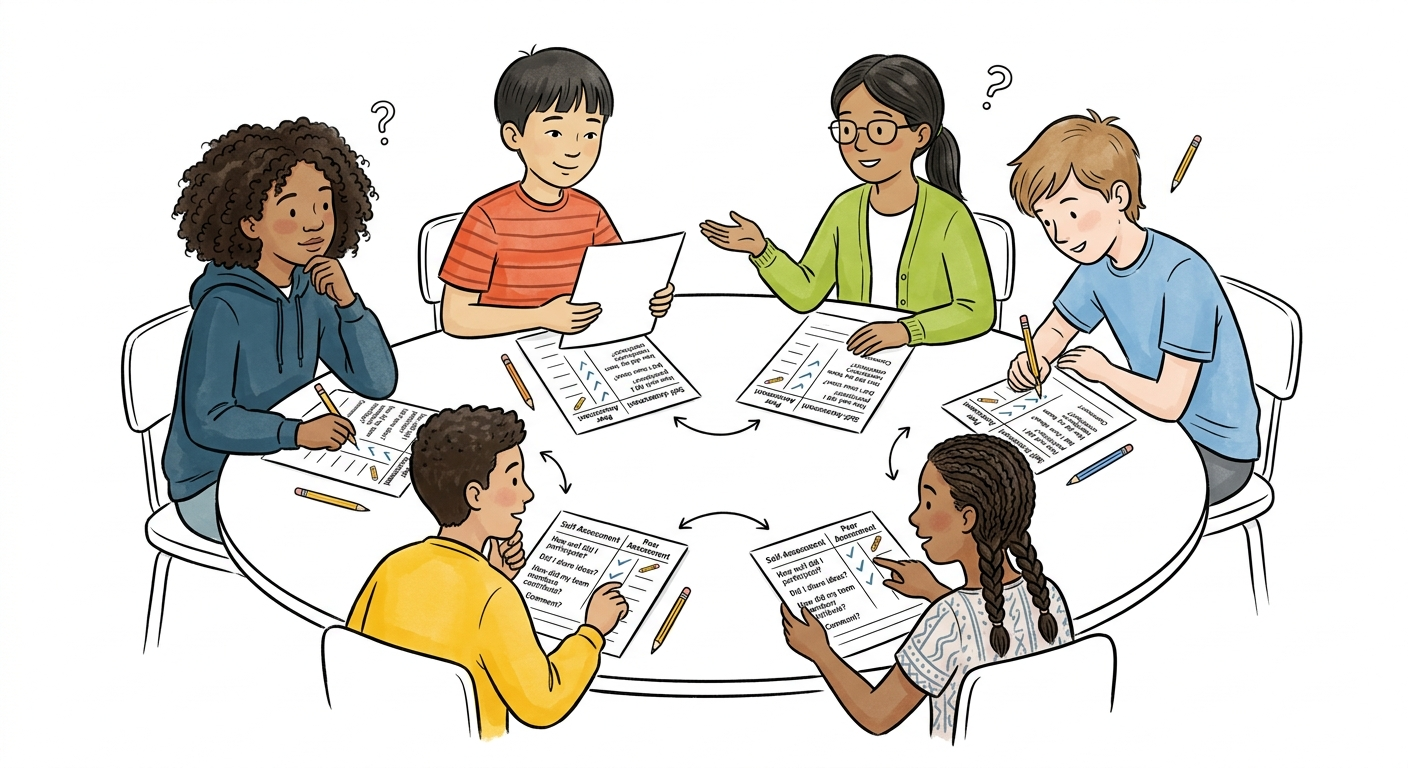
A student might recognize, My questions help my group clarify important ideas in the text, so I think I am in the developing stage. Next time, I want to ask a question that encourages my group to make a connection or think more deeply about what we are reading.
Peers can use the same continuum to provide feedback grounded in evidence. For example, your question helped us think about why the author included that information. Next time, you might ask a follow-up question that encourages us to consider a different perspective.
Teachers might create a continuum for each of the four comprehension lenses (summarize, question, clarify, and predict). They can also create one focused on the collaborative skills required to engage in a productive reciprocal teaching discussion. These continuums can be revisited each time the students use a strategy. This allows them to track their growth, identify areas for continued improvement, and set new goals over time. This process can help students become more aware of how they are making meaning from a text and more intentional about the strategies they use when comprehension breaks down.
From Explicit Instruction to Independent Readers
Reciprocal teaching requires an investment of time and energy on the front end. Teachers must explicitly teach the comprehension lenses, model the thinking behind them, guide students through supported practice, make the full routine visible, and provide feedback as students begin using it with peers. That process takes time, but the goal is not simply to teach students how to navigate a reciprocal teaching routine. The larger goal is to help students become more strategic, metacognitive readers.
We want them to recognize what’s important, ask questions that deepen their understanding, notice when comprehension breaks down, use strategies to resolve confusion, and draw on evidence to anticipate what comes next. These are skills students can carry beyond reciprocal teaching and apply whenever they encounter a challenging text in any class.
When we invest in a thoughtful onboarding process, we can gradually shift more of the cognitive work to students. Instead of the teacher always asking the questions, identifying the most important ideas, clarifying confusion, or prompting students to make connections, students learn how to do more of that work themselves and in collaboration with their peers. That is the payoff of the investment up front. Students are not just simply learning a new strategy; they are learning how to make meaning for themselves.
One response
The question “could we leave it out without losing the meaning” is the one I wish someone had drilled into me earlier. When I summarize something I’ve just read, I tend to hang on to the vivid example and drop the plain sentence that actually carries the argument, because the example is what sticks. Asking that question out loud usually catches it. If the rest of the group thinks the summarizer cut something essential, do you let them argue it out, or do you step in?