
Related Podcast
Guided notes can be incredibly effective instructional supports when they are intentionally designed and used strategically. For multilingual learners, students with individualized education plans (IEPs), students who struggle with organization or processing speed, or learners who are still developing note-taking skills, guided notes can reduce cognitive load and help students focus on key concepts during direct instruction.
Most teachers use guided notes to keep students engaged during lectures or video lessons. They want students to leave class with accurate notes they can reference later. They also want students to feel supported rather than overwhelmed by the pace of delivery or the complexity of the content.
As I visit classrooms, I’ve noticed that what many teachers are calling “guided notes” are actually much closer to cloze (closed) notes. Instead of functioning as structures that support students in processing ideas, making connections, organizing information, and engaging in meaning-making, these notes often look more like fill-in-the-blank worksheets tied directly to a lecture transcript or text-heavy slide deck.
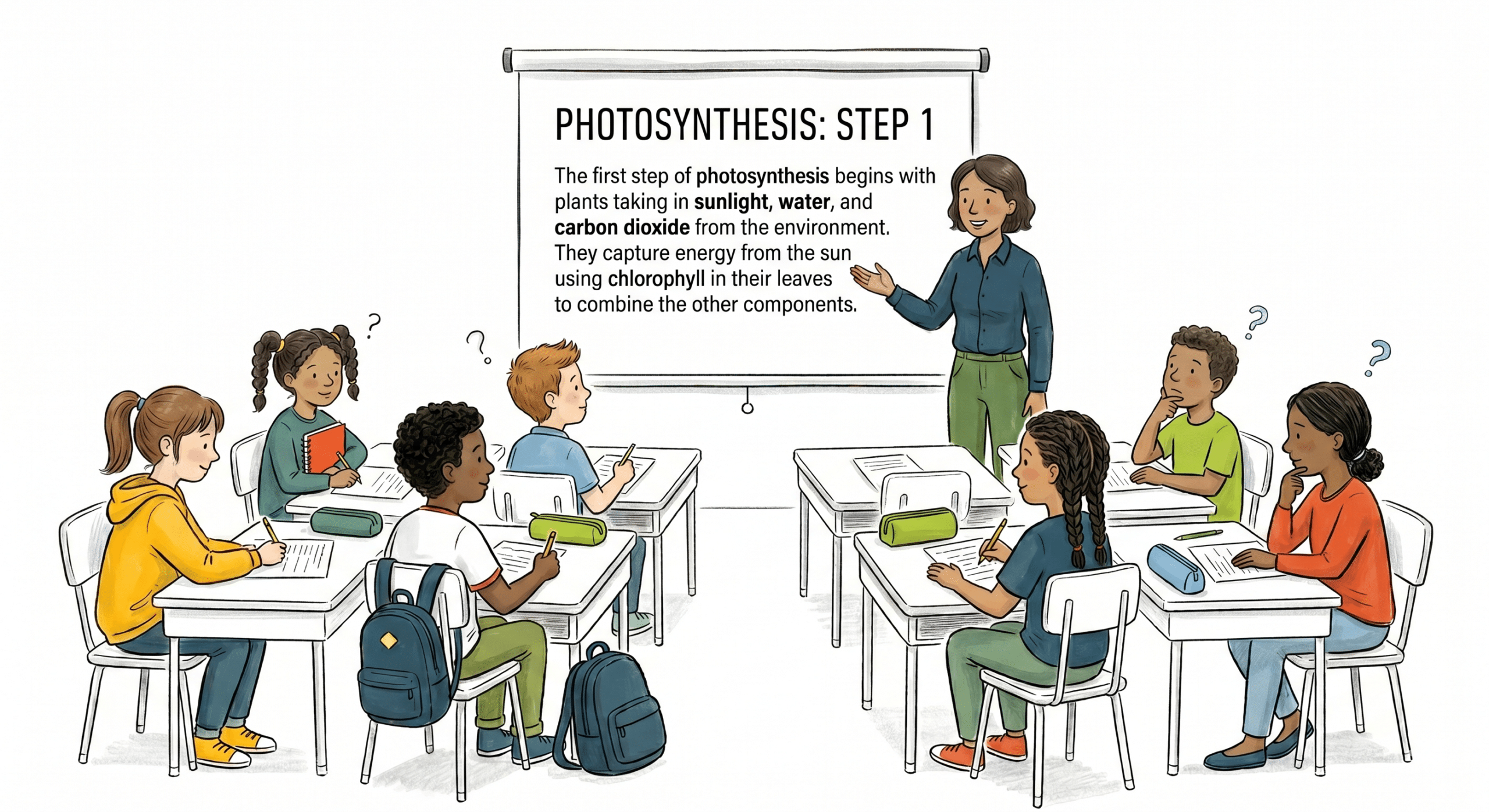
In this post, I want to explore what guided notes are, who benefits most from them, the difference between guided and cloze notes, and what it looks like to design note-taking supports that preserve active cognitive engagement during direct instruction.
Ultimately, the goal of a scaffold, such as guided notes, should be to support thinking and help students develop the skills and confidence to become increasingly independent learners.
Guided Notes Can Be Powerful Supports
I want to be clear that guided notes are not the problem. My concern is how guided notes are being designed and used in classrooms. Decades of research suggest that guided notes can improve everything from note quality to engagement and achievement.
They are especially helpful when students are learning dense, fast-paced, or conceptually complex material (Glodowski & Thompson, 2018; Greenfeld et al., 2020; Konrad et al., 2010). Studies have shown that students using guided notes often produce more accurate and complete notes compared to their peers who take notes independently. As a result, they have stronger study resources to reference when completing work or preparing for an assessment (Austin et al., 2004; Glodowski & Thompson, 2018; Haydon et al., 2011).
Who Benefits Most From Guided Notes?
Research suggests that guided notes can benefit all learners, but the impact appears to be especially significant for students with disabilities, students who struggle with organization, and learners who need more time to process information (Boyle & Rivera, 2012; Haydon et al., 2011; Konrad et al., 2009).
For these students, guided notes can reduce the executive-functioning demands associated with deciding what information is important and how to organize it. Instead of splitting their attention between listening, processing, and attempting to capture everything being said, students can focus more of their cognitive energy on understanding the concepts, ideas, and processes being presented (Haydon et al., 2011; Konrad et al., 2009).
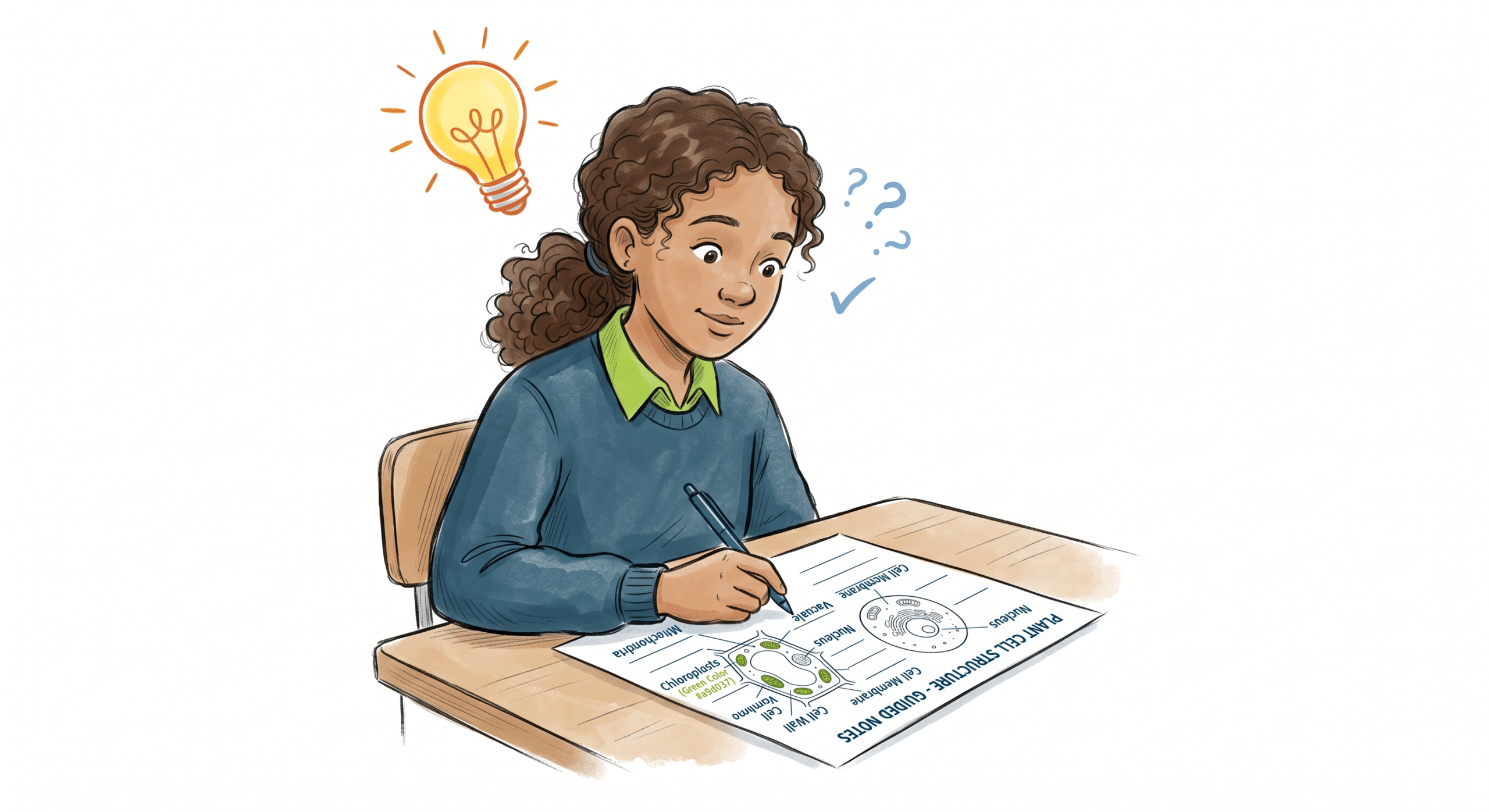
Research specifically focused on students with disabilities found that guided notes improved both note accuracy and assessment performance. Some studies reported gains of 20-25% when the guided notes were paired with opportunities for special education students to review and reflect (Boyle & Rivera, 2012; Boyle, Forchelli, & Cariss, 2015; Lazarus, 1993).
Similarly, multilingual learners benefit significantly from guided notes, which provide structural and visual supports that reduce the linguistic load of fast-paced, vocabulary-dense lectures. Guided notes help multilingual learners focus on key terms and conceptual understanding without requiring them to simultaneously determine what information matters most while processing instruction in another language (Boyle & Rivera, 2012; Elcoro et al., 2020). This aligns with the broader body of research suggesting that structured note-taking supports comprehension and long-term academic outcomes for English learners by helping them organize information, identify key ideas, and engage actively with academic language during direct instruction.
Guided Notes, Cloze (Closed) Notes, and Completed Notes: What’s the Difference?
One of the challenges in this conversation is that the terms guided notes and cloze (closed) notes are often used interchangeably, even though they support very different kinds of thinking and learning. This is where I think the confusion sometimes happens in classrooms. Many of the “guided notes” I observed students using were actually much closer to cloze notes. Students were not actively engaging with the content; they were identifying the bolded words in paragraphs and copying them into blanks. Before unpacking how guided notes and cloze notes differ, it helps to map out the broader landscape. There are three note-taking scaffolds: guided notes, cloze (or closed) notes, and completed notes. Together, they form a continuum of teacher-provided support.
- Guided notes ask students to do significant cognitive work within a teacher-provided structure.
- Cloze notes, also called closed notes, provide most of the content with select words or phrases removed for students to fill in.
- Completed notes are fully filled in before instruction begins, allowing students to listen and follow along without writing.
The terms “cloze” and “closed” describe the same format; however, “completed notes” is a distinct, more supportive option for students whose accommodations require it. The sections that follow unpack guided and cloze notes in greater depth.
Guided Notes
Guided notes are teacher-designed supports that provide students with a structure for organizing and elaborating on information during direct instruction. They might include headings, unlabeled diagrams or timelines, worked examples, key vocabulary, question stems, or partially completed graphic organizers. Guided notes require students to actively process information by:
- Generating explanations
- Making connections
- Labeling visuals
- Analyzing examples
- Solving problems
- Defining terms in their own words
- Comparing and contrasting
- Capturing their thinking
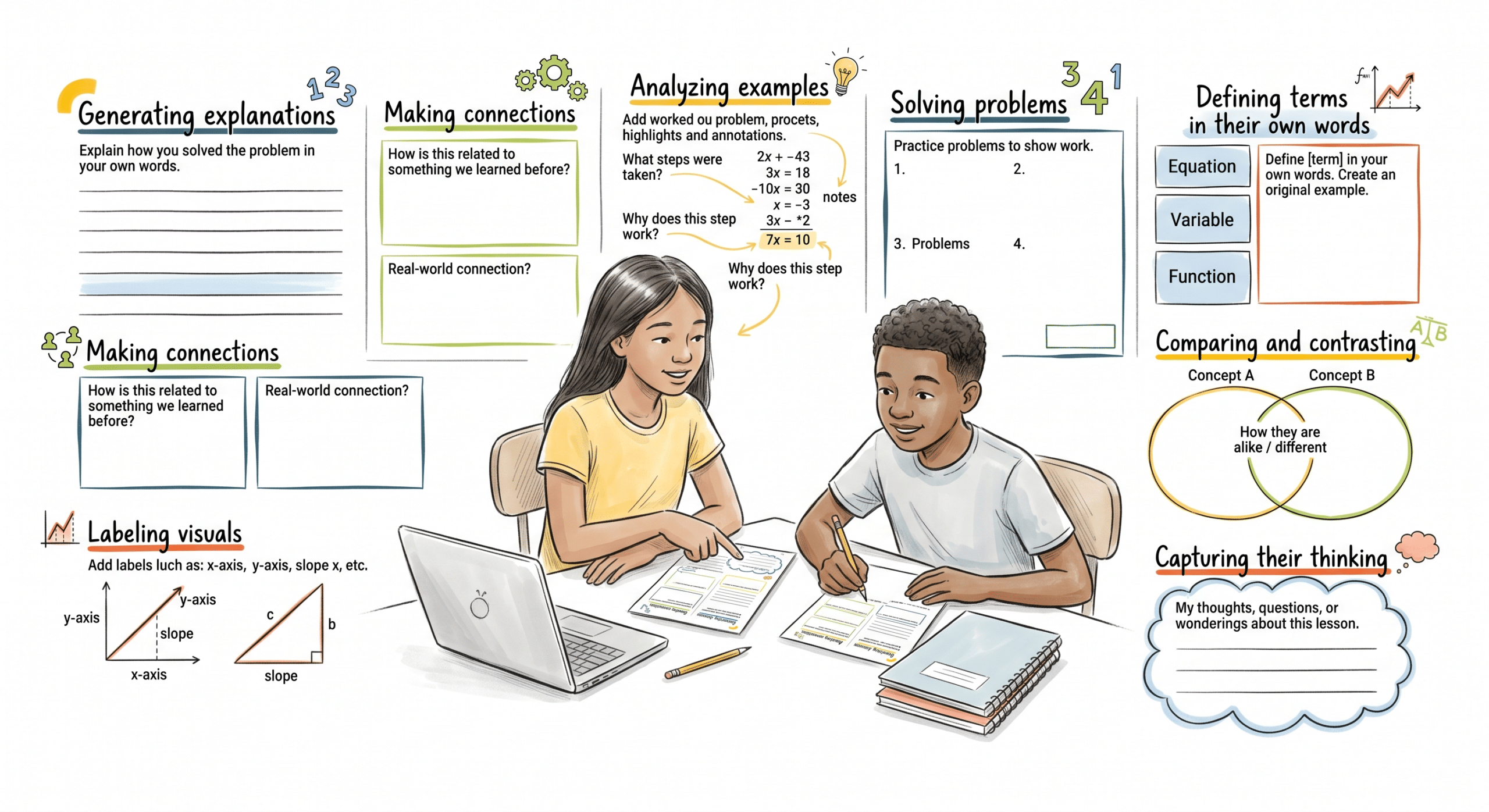
Guided notes require students to actively engage with the information. When done well, guided notes position note-taking as a process of meaning-making rather than simple transcription. Students are thinking about relationships between ideas, making a bridge to prior knowledge, summarizing concepts, and processing information in ways that support deeper understanding and retention. That active cognitive engagement is one reason guided notes have been linked to stronger engagement, more complete notes, and higher achievement.
Cloze (Closed) Notes
In a cloze note format, students are typically given an almost complete set of notes, a lecture transcript, or a printed slide deck with select words or phrases removed. As the teacher presents information, students fill in the missing blanks. Because most of the organization, wording, and structure have already been provided, cloze notes reduce the cognitive, organizational, and motor demands associated with taking notes. For some students, that level of support may be necessary and appropriate. Most often, teachers encounter this level of accommodation in an IEP.
Students with specific IEP accommodations related to writing, processing speed, working memory, attention, or executive functioning may benefit from cloze notes because they significantly reduce transcription demands and help students access the information presented.
Completed Notes
Completed notes go one step further along the support continuum. Students receive a fully filled-in set of notes. That could take the form of a printed version of the slide deck, a teacher’s outline, or a transcript of the lecture or video lesson before instruction begins. Rather than writing during the lesson, students follow along, listen, and use the document as a study reference afterward.
Completed notes are typically reserved for students whose IEPs, 504 plans, or language needs make writing during instruction a barrier to accessing the content. However, for most other learners, removing note-taking also removes a meaningful opportunity for cognitive engagement. That is why guided notes, which preserve thinking while reducing transcription demands, tend to produce stronger learning outcomes for the broader student population.
Tips for Creating Note-Taking Supports for Inclusive Classrooms
Teachers serving students with special needs in their general education classrooms are likely wondering: How do I realistically do this in an inclusion classroom where some students need cloze notes, and others would benefit more from guided notes?
One way to make this more manageable in an inclusion classroom is to rethink the structure of the lesson itself. For example, teachers using the station rotation model can provide direct instruction to small groups of students and adjust the level of note-taking support based on each group’s needs.
In one rotation, the teacher might work with students who require cloze or completed notes and provide more explicit, guided instruction with reduced writing demands. In another rotation, teachers might use a guided-note template that prompts students to define concepts in their own words, pause to process information, discuss ideas with peers, label visuals, or collaboratively add details to their notes.
Small-group instruction makes it easier to differentiate not only the level of support students receive but also the level of cognitive engagement. Of course, not every teacher is comfortable designing a station rotation lesson or has the flexibility to provide small-group direct instruction every day. The reality is that many general education teachers are trying to balance a wide range of learning needs, accommodations, language proficiencies, and levels of independence within a whole-group lesson structure.
Below are four tips to help teachers create note-taking scaffolds for diverse groups of students.
1. Start with one strong guided notes template for the class.
Create a note-taking structure that mirrors the flow of your instruction and supports organization and meaning-making for all learners. It might include:
- Cornell-style notes
- Timelines
- Graphic organizers
- Venn diagrams for comparing and contrasting
- Worked examples
- Problem-solving steps broken down
- Unlabeled diagrams or visuals
- Space for definitions, summaries, questions, or connections
The goal is to build in opportunities for students to actively process information, not just record it.
2. Adjust the level of support for students who need clozed or completed notes.
Instead of designing entirely separate materials, modify and add to the core guided notes template. Simply make a copy of the original guided notes and consider doing the following with the adapted cloze notes version:
- Pre-fill portions of definitions, examples, or procedures
- Leave only key vocabulary and short phrases blank
- Provide partially completed diagrams
- Annotate worked examples explaining the process
- Provide a copy of the slide deck in PDF form for students to reference
This keeps all students working from the same overall structure and content while adjusting the amount of cognitive and organizational support provided.
3. Target the most cognitively demanding sections for additional support.
Not every part of the instructional session will demand the same level of scaffolding. New vocabulary, multi-step procedures, lengthy explanations, or highly conceptual material may require more structured support for some learners. Other sections can remain more open, allowing students to:
- Summarize ideas
- Label visuals
- Make connections
- Explain thinking
- Solve problems
- Generate questions
That balance between teacher support and student meaning-making is important because students need opportunities to actively process information, moving new learning beyond working memory and into long-term memory.
4. Leverage collaboration, colleagues, and technology.
General education teachers should not feel like they have to solve this challenge alone. When possible:
- Co-plan with special education teachers or support staff to identify which students truly require cloze or completed notes as part of their accommodations.
- Work in PLCs or collaborative teaching teams to develop shared guided notes templates and scaffolds across units or courses.
- Advocate for release time or professional learning time dedicated to designing differentiated instructional supports and resources.
- Use AI tools to generate guided notes templates, create multiple scaffolded versions of the same notes, transform guided notes into cloze-note formats, or adjust the level of support provided.
Technology can make this work more manageable, but it should never replace a teacher’s professional judgment. AI tools can help teachers generate these resources, but it is critical that teachers review anything AI generates for accuracy, bias, accessibility, and appropriateness in relation to specific student needs and accommodations.
Examples of Guided Notes That Promote Active Learning
Below are a few examples of guided-note templates designed to encourage active cognitive engagement during direct instruction. Instead of positioning students as passive recipients of information, these note-taking structures ask students to process ideas, make connections, define concepts in their own words, label visuals, solve problems, and collaborate with peers as the learning unfolds.
These kinds of guided notes also require intentional teacher moves. Effective implementation demands chunking instruction and pausing at strategic moments to give students time to process and reflect. Cooperative learning structures can also invite students to discuss ideas, compare thinking, and support one another as they complete their notes. The goal is not simply to fill in the blanks. It is to actively engage students in meaning-making while information is being presented.
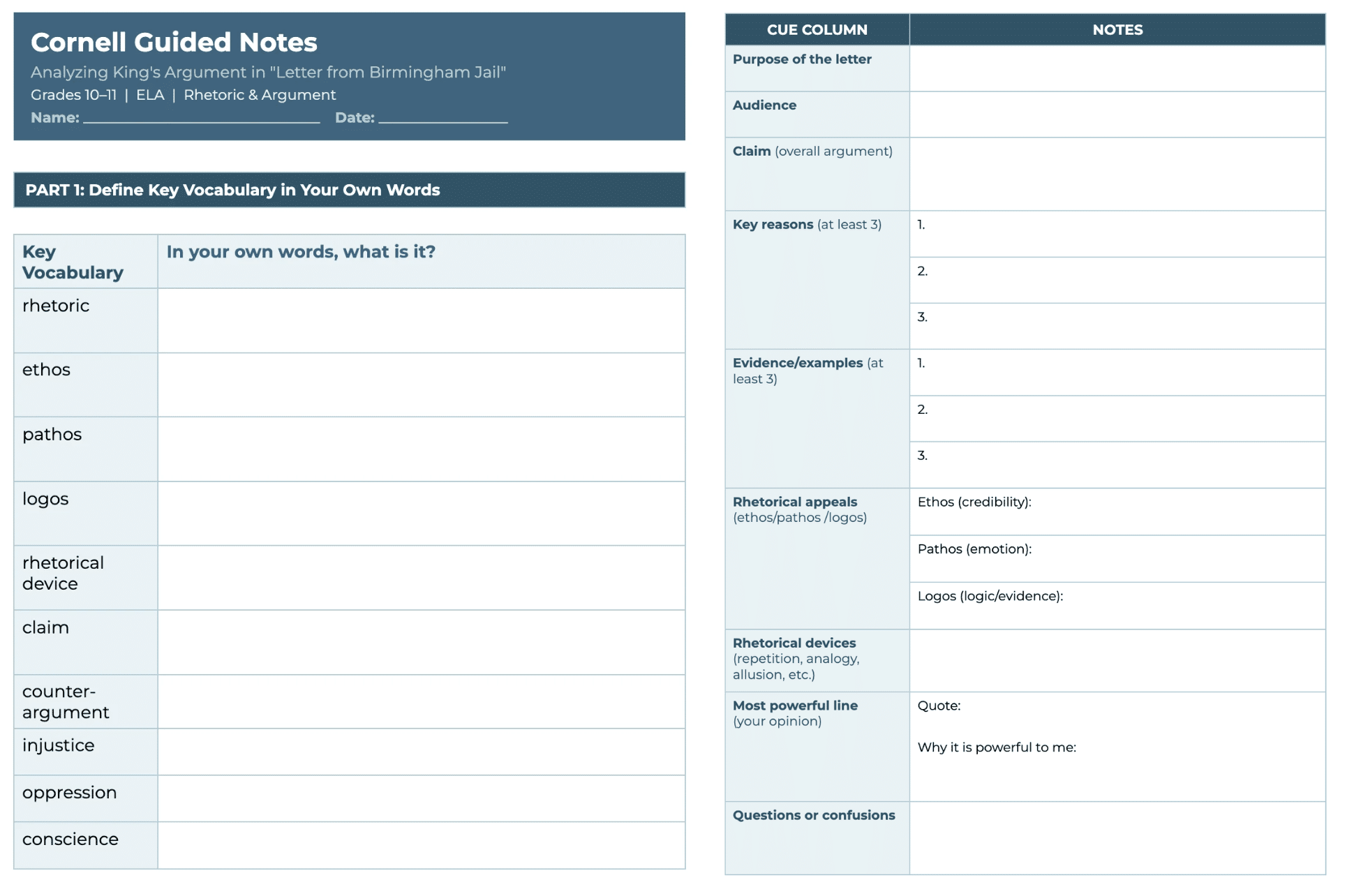
ELA Example: Using Guided Notes to Analyze Argument and Rhetoric
In this example, students use a Cornell-style guided-note template while analyzing Martin Luther King Jr.’s argument in “Letter from Birmingham Jail.” Instead of copying information from slides, students identify claims and evidence, analyze rhetorical appeals and devices, summarize ideas in their own words, and connect the text to contemporary issues.
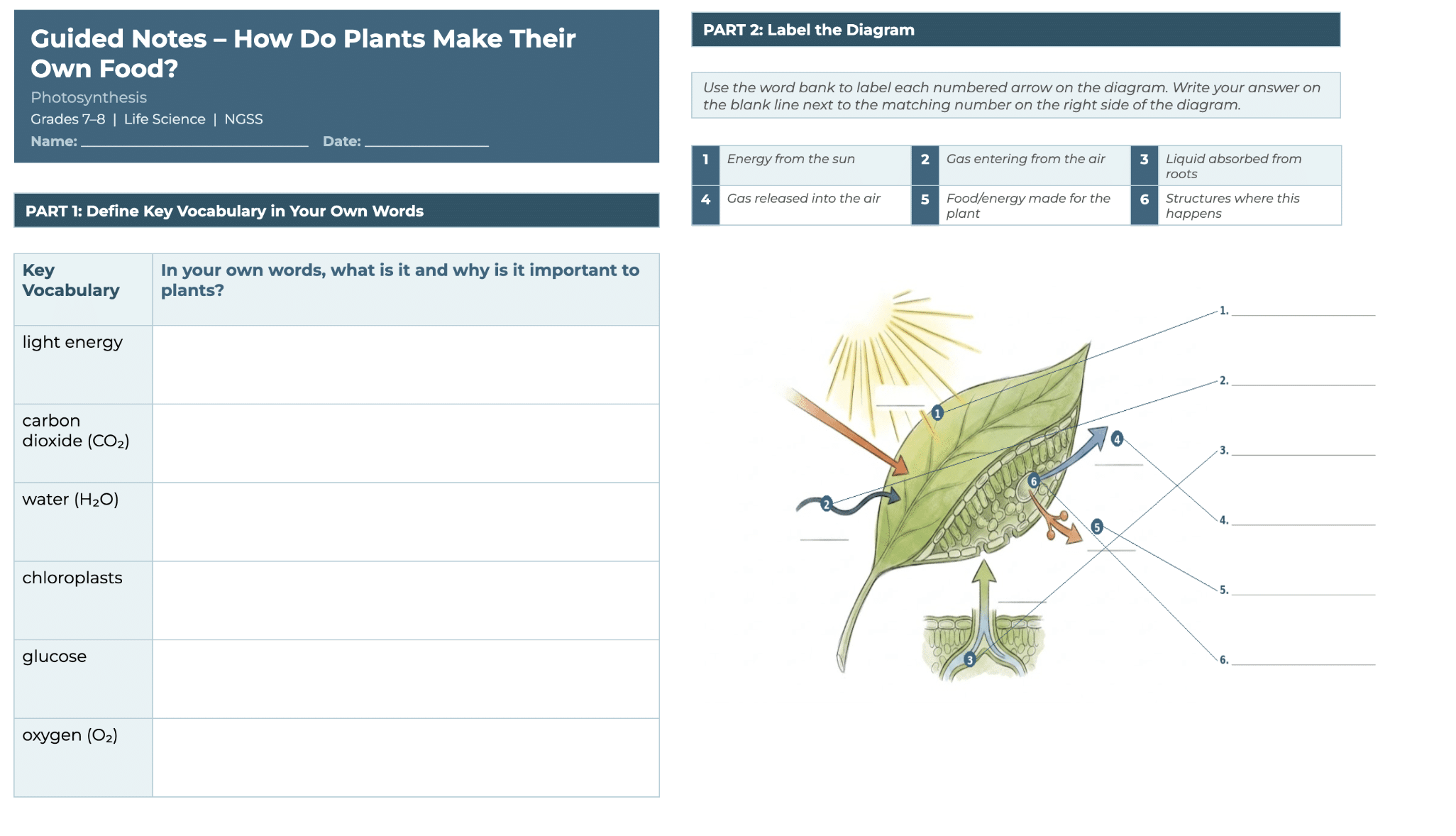
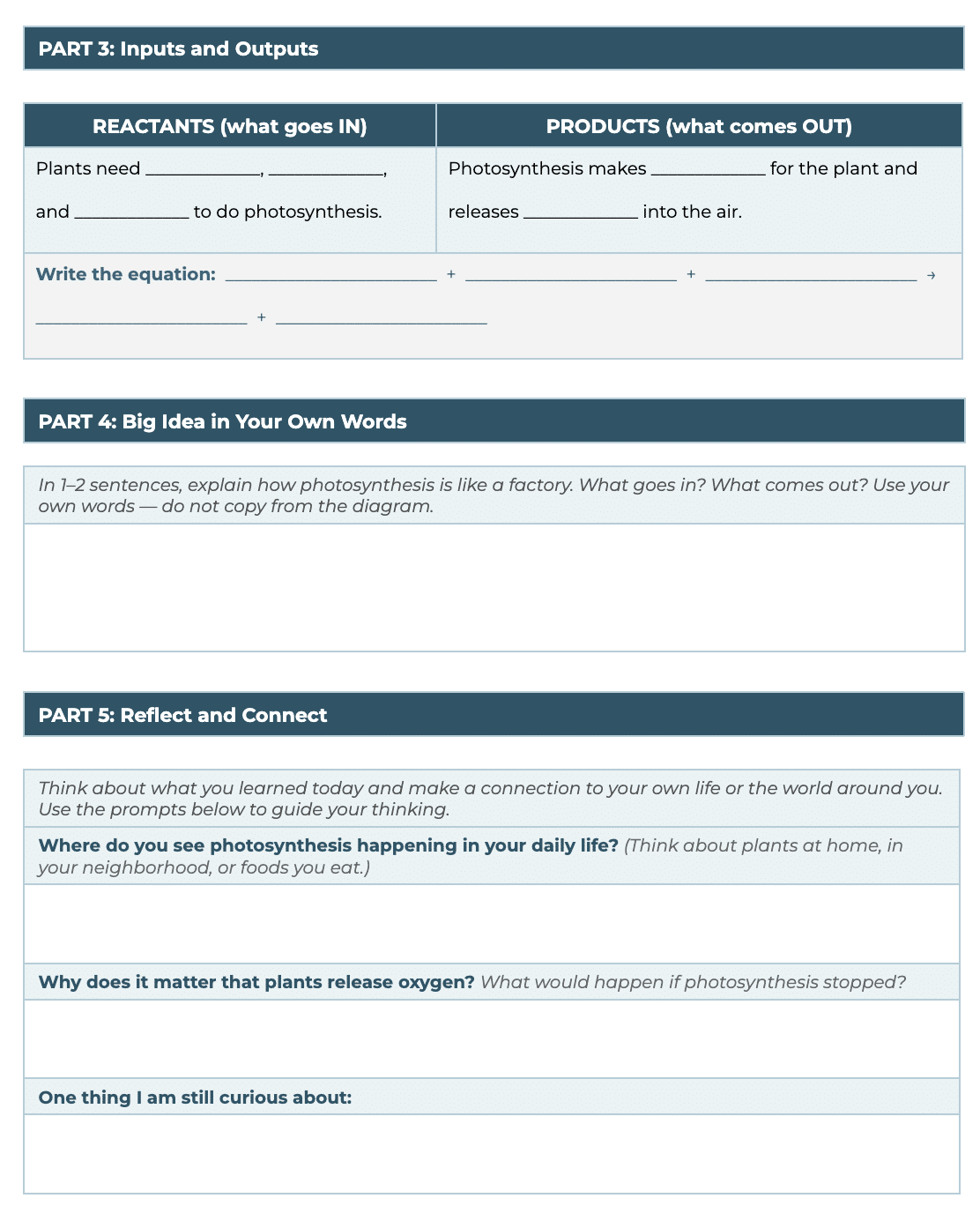
Science Example: Using Guided Notes to Visualize and Explain Photosynthesis
In this middle school life science example, students use guided notes to actively process the concept of photosynthesis. They define vocabulary in their own words, label and interpret a diagram, identify inputs and outputs, and reflect on real-world connections. The diagram component encourages students to connect visual representations to scientific concepts, helping them organize and process information more meaningfully than simply copying definitions or filling in isolated blanks.
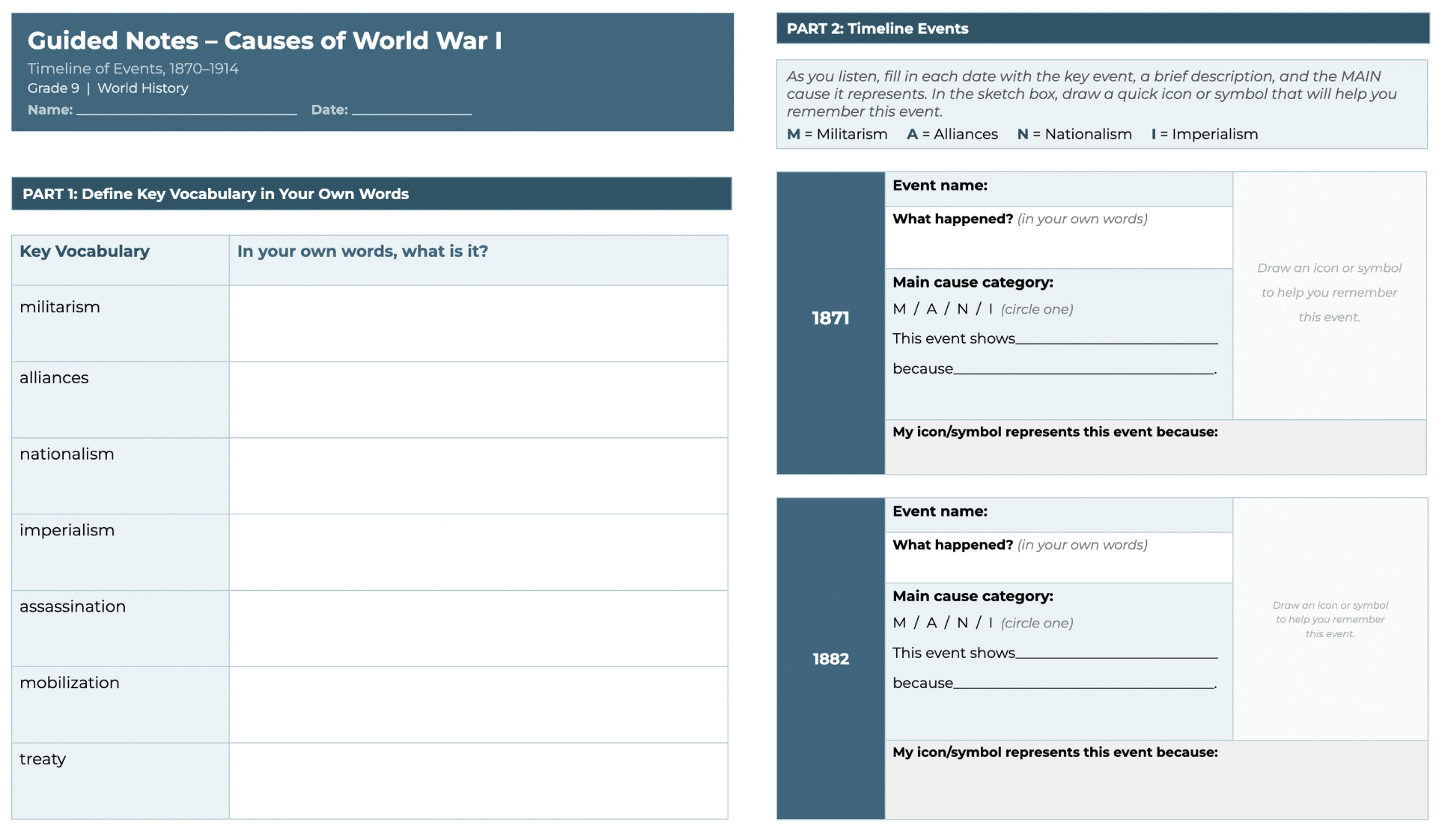
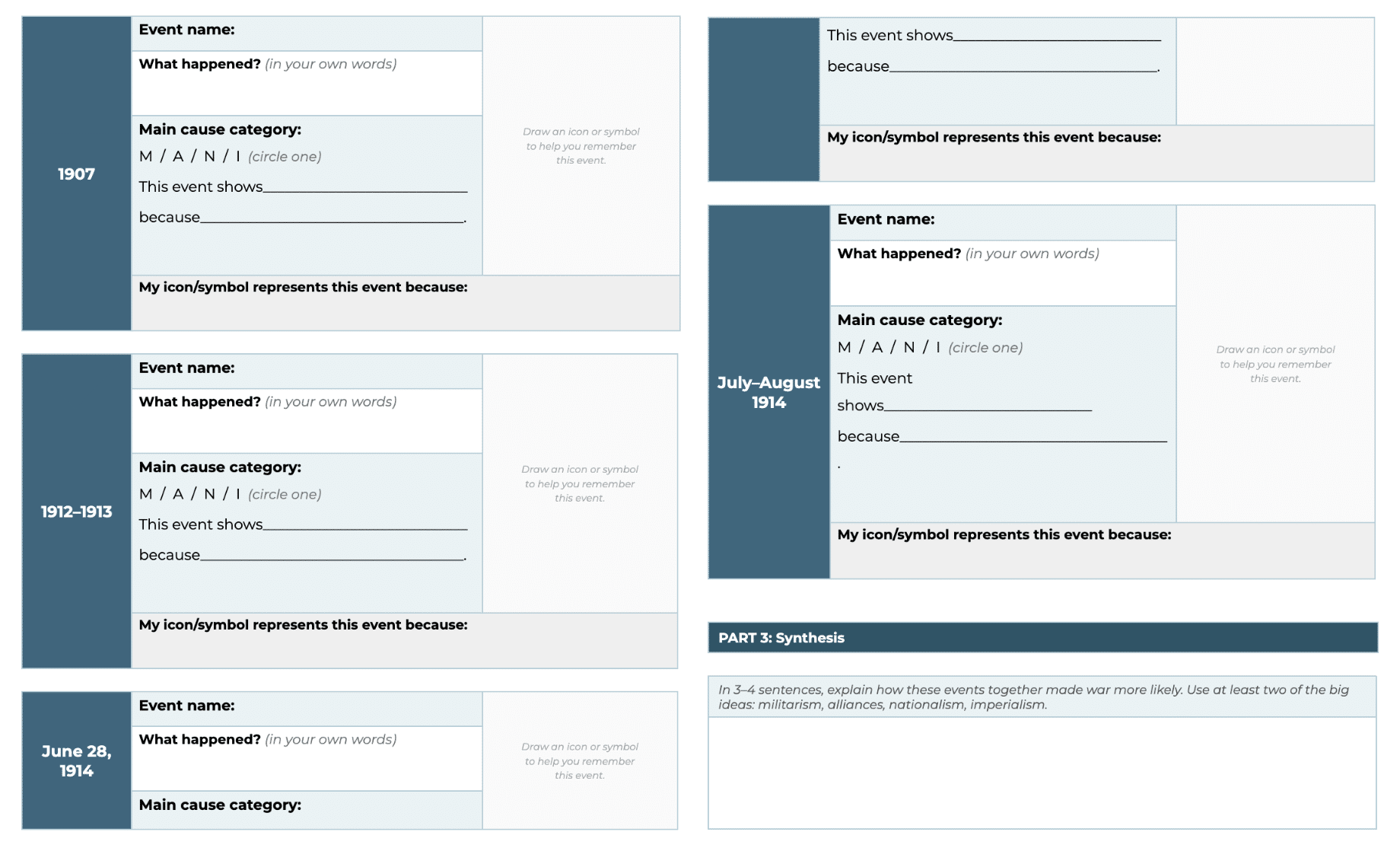
History Example: Using Guided Notes to Analyze the Causes of World War I
In this world history example, students use a timeline-based guided-note template to organize and analyze the events leading up to World War I. Instead of simply recording dates and facts, students define key vocabulary in their own words, summarize events, justify their thinking, and draw visual symbols to reinforce understanding.
Math Example: Solving Systems of Linear Equations
In this high school algebra example, students use a Cornell-style guided-note template to actively process a direct instruction lesson on solving systems of linear equations. Instead of simply copying steps from the board, students draft definitions in their own words before hearing the formal version, predict the three possible intersection cases before seeing them sketched, annotate each algebraic move with the property of equality that justifies it, and build their own decision matrix for choosing between graphing, substitution, and elimination.
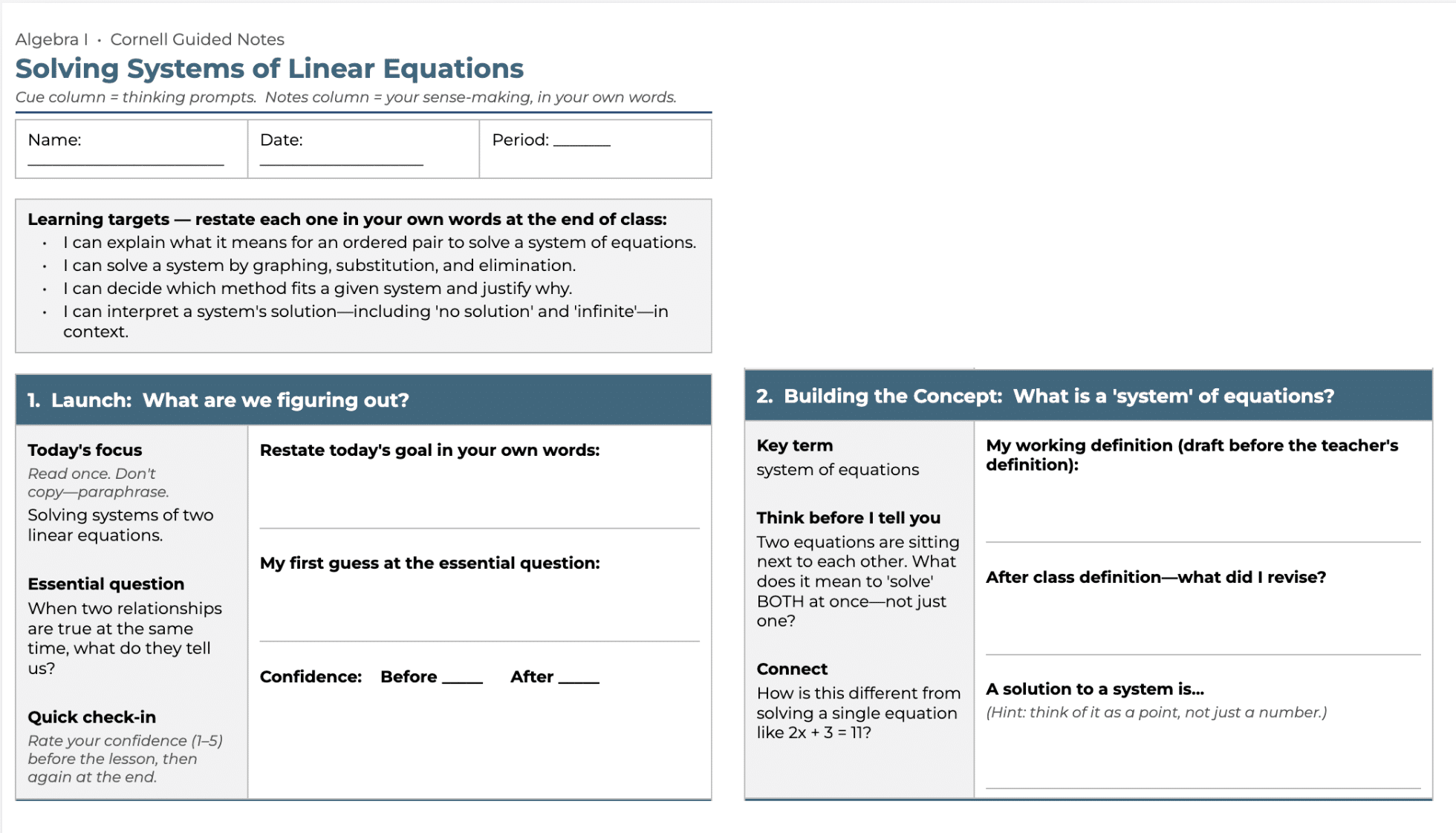
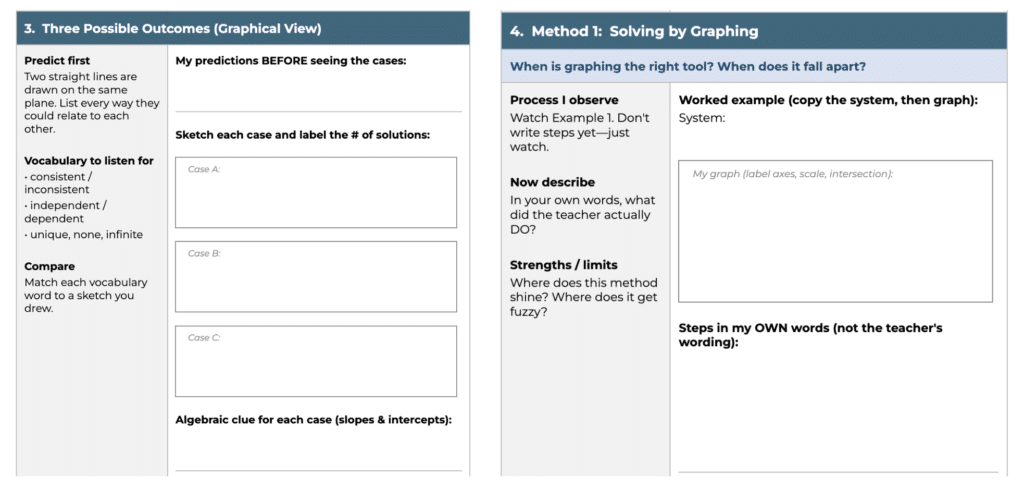
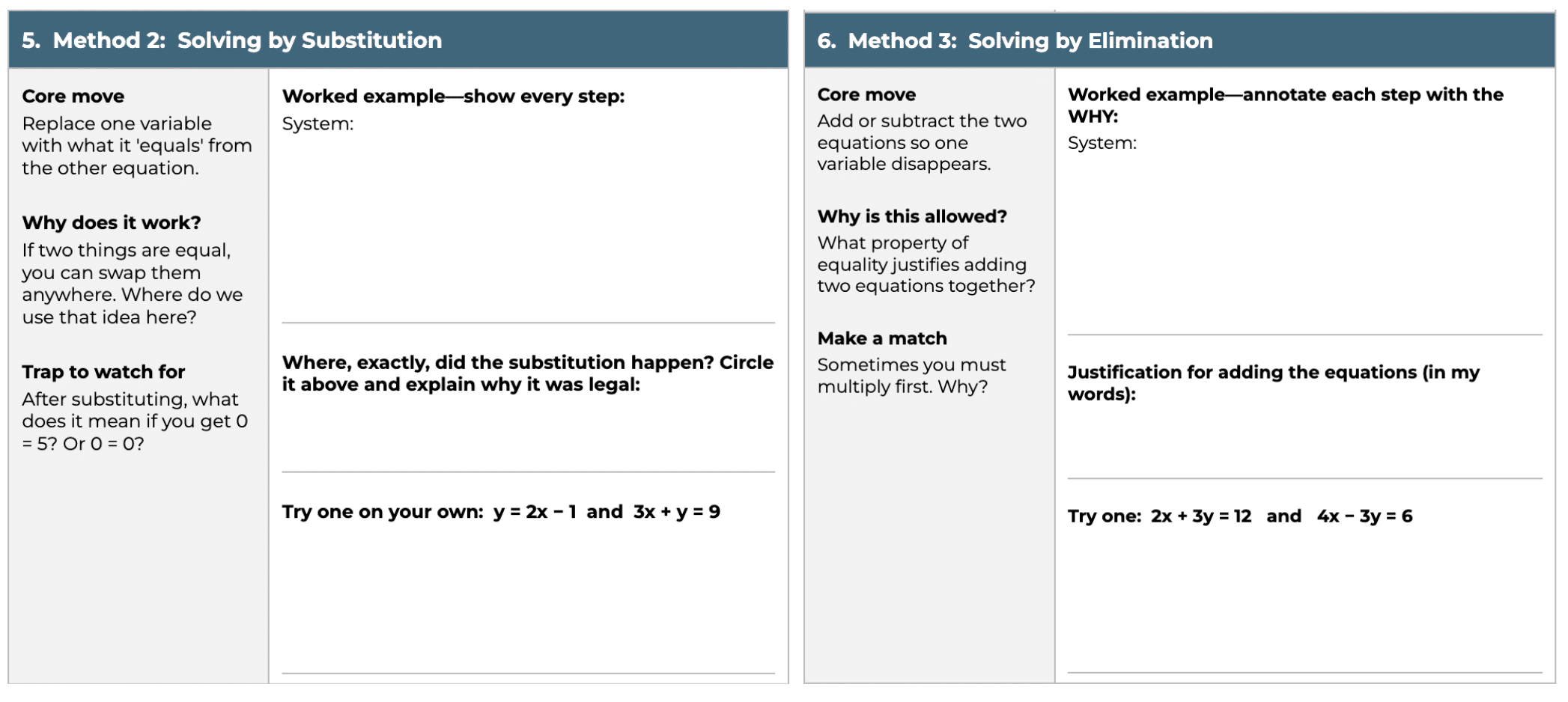
Because guided notes require students to process information, make connections, and generate explanations, direct instruction needs to be intentionally chunked with strategic pauses for processing. Those pauses create opportunities for students to think, sketch, discuss ideas with peers, compare interpretations, and complete the notes collaboratively before moving on to the next section of content.
Spotlight: AI as a Design Partner
For teachers concerned about the time it takes to create these templates, I used AI tools strategically to streamline the process. I used Claude to help me generate and organize the guided note structures based on the lesson focus, objectives, and target standards. I used Gemini to create the visual for the science example.
Teachers can use my REFINE AI prompting acronym to experiment with an AI chatbot, such as Claude or Gemini, to design their guided notes, or use the fill-in-the-blank prompt below to get started.
Example Fill-In-The-Blank AI Prompt
You are a curriculum designer. Design a Cornell-style guided-note template for a direct instruction lesson on [INSERT TOPIC] for [INSERT GRADE LEVEL/SUBJECT]. Align the guided notes with these lesson objectives, standards, and/or attached slide deck [INSERT OBJECTIVES/STANDARDS].
The guided notes should support active cognitive engagement during instruction, not passive copying or transcription. Include clear headings, organizational structure, and opportunities for students to define concepts in their own words, make connections, compare ideas, explain thinking, synthesize information, and/or actively engage with visuals, diagrams, examples, problems, or data when appropriate.
The guided notes should function as a scaffold that supports thinking without removing the cognitive work required for learning. Do not create cloze notes, fill-in-the-blank lecture transcripts, or fully completed notes. Avoid structures that simply ask students to copy information directly from slides or teacher explanations. Instead, position note-taking as a process of meaning-making, active processing, and sense-making during direct instruction. Write in a concise, student-friendly format that is visually organized, easy to follow during instruction, and appropriate for the grade level.
For teachers balancing heavy workloads, inclusion supports, differentiation, and lesson planning, AI can make the design process significantly more manageable. That said, these tools are most powerful when they function as thought partners in the design process, not replacements for teachers’ experiences and intentional instructional decision-making.
Final Thoughts
Guided notes are helpful scaffolds for students when they are designed thoughtfully and used strategically. They help students manage cognitive load, engage with complex content, organize information, and participate more confidently during direct instruction. But we also need to be careful that our scaffolds do not unintentionally remove the cognitive work required for learning. Cognitive engagement helps move information beyond working memory and into long-term memory.
It is also important to remember that scaffolds are intended to be temporary supports. The goal of guided notes should be to gradually help students build the confidence, organizational skills, and note-taking strategies necessary to become more independent learners over time. We do not want students to become unnecessarily dependent on scaffolds, which is why gradual release matters.
As students develop stronger note-taking and processing skills, guided notes can become increasingly open-ended, requiring students to assume greater cognitive responsibility for identifying key ideas, organizing information, and capturing their thinking. Part of our responsibility as educators is to prepare students to navigate increasingly complex learning experiences with greater confidence, independence, and agency.
Reflecting on Your Current Practice
As you reflect on your own practice, consider the following questions:
- Are my note-taking supports reducing barriers while still preserving thinking?
- Are students actively processing ideas or primarily copying information?
- Where can I build in more opportunities for pausing, discussion, reflection, sketching, or synthesis?
- Am I gradually releasing responsibility over time so students develop greater independence?
The goal of this reflective practice is to understand if our current approach to support still leaves room for students to think and make meaning.
Want More Guided Note Templates and Resources?
I will be creating and sharing additional guided-note templates and related resources in the coming weeks. If you’d like those delivered to your inbox every two weeks, join my email list 👇🏻. I share practical strategies, templates, and resources designed to support more active, student-centered learning experiences.
References
Austin, J. L., Lee, M., & Carr, J. E. (2004). The impact of guided notes on postsecondary student achievement. Journal of Behavioral Education, 13(3), 217–232.
Boyle, J. R., & Rivera, T. Z. (2012). Note-taking techniques for students with disabilities: A systematic review of research. Learning Disability Quarterly, 35(3), 131–143.
Boyle, J. R., Forchelli, G. A., & Cariss, K. (2015). Note-taking interventions to assist students with disabilities in content area classes. Preventing School Failure, 59(3), 186–195.
Elcoro, M., Ghirardi-Broughton, K., & Hebert, L. (2020). Guided notes in undergraduate instruction: More than fill-in-the-blanks. Journal of Scholarly Engagement, 3(2), 48–62.
Glodowski, K. R., & Thompson, R. H. (2018). The effects of guided notes on college students’ performance in an introductory psychology course. Journal of Behavioral Education, 27(4), 1–24.
Greenfeld, R., Starke, K., & Evans, A. (2020). The benefits of guided note-taking in the high school classroom. EdVoice, 13, 1–8.
Haydon, T., Mancil, G. R., Kroeger, S. D., McLeskey, J., & Lin, W.-J. (2011). A review of the effectiveness of guided notes for students with disabilities. Preventing School Failure: Alternative Education for Children and Youth, 55(4), 226–231
Konrad, M., Joseph, L. M., & Eveleigh, E. (2009). A meta-analytic review of guided notes. Education and Treatment of Children, 32(3), 421–444.
Lazarus, B. D. (1993). Guided notes: Effects with secondary and postsecondary students with mild disabilities. Education and Treatment of Children, 16(3), 272–289.
15 Responses
Thank you for your remarks and recommendations. My PLC has been working on exactly this conundrum. We make beautiful “guided notes” and have good student engagement, but when it is time to release, students are not always able to move on independently. It feels as if we are over-scaffolding and that our notes are more akin to “cloze” than what we are hoping. I have some ideas based on your comments above, but would also love to hear your perspective. How would you design guided notes for high school math? (Algebra, geometry, algebra 2, probability/statistics)
Hi Andrea,
In math classrooms, I would think about guided notes less as “fill in the missing step” documents and more as structured thinking tools. Instead of pre-filling most of the process and asking students to insert a number, variable, or vocabulary word, I would design notes that prompt students to explain relationships, identify patterns, justify decisions, compare strategies, annotate visual models, and make connections between representations.
For example, in Algebra, instead of students copying a completed process for solving systems of equations, guided notes might ask:What does the solution represent in the context of the graph? How does the graph change when the slope changes? Compare substitution and elimination. When might one strategy be more efficient? Explain why each step in the process preserves equality.
In Geometry, students might: label diagrams, sketch transformations, explain why a theorem applies, compare shapes or proofs, annotate visual patterns, identify what information is missing and why it matters, etc.
In Statistics or Probability, guided notes could ask students to: interpret data displays, predict outcomes before calculating, explain what a result means in context, compare distributions, justify conclusions using evidence, etc.
I personally like to structure the notes using the Cornell Notes style with the terms, formulas, example problems, visuals, etc. are on the left-hand side of the page and the right-hand side if where the students capture their thinking. The important thing is that students are still doing cognitive work while the notes provide structure and support.
I also think intentional chunking and pausing matter tremendously in math instruction. Too often, students watch a teacher complete several steps in rapid succession, then attempt to copy everything down without processing why the steps matter. Guided notes work best when teachers pause periodically and give students opportunities to process with peers, explain reasoning, attempt a step independently, compare approaches, ask questions, summarize what they notice, etc. That processing time is critical for helping students move beyond procedural mimicry toward conceptual understanding.
I will work to create a math example to add to this post!
Best,
Catlin
This is a great article! I have struggled with creating guided notes that don’t simply ask the students to record and fill in. Can you give an example of the prompt you would use in AI to help with this?
Thank you, Marie! That is a great questions.
Below is an example of a prompt I would use with Gemini (or another chatbot) to create a guided note template. If I am working from a slide deck, I would attach that for the AI to reference the flow of information.
Example Prompt:
You are a curriculum designer. Design a Cornell-style guided-note template for a direct instruction lesson on [INSERT TOPIC] for [INSERT GRADE LEVEL/SUBJECT]. Align the guided notes with these lesson objectives, standards, and/or attached slide deck [INSERT OBJECTIVES/STANDARDS]. The guided notes should support active cognitive engagement during instruction, not passive copying or transcription. Include clear headings, organizational structure, and opportunities for students to define concepts in their own words, make connections, compare ideas, explain thinking, synthesize information, and actively engage with visuals, diagrams, examples, problems, or data when appropriate for the content area. The guided notes should function as a scaffold that supports thinking without removing the cognitive work required for learning. Do not create cloze notes, fill-in-the-blank lecture transcripts, or fully completed notes. Avoid structures that simply ask students to copy information directly from slides or teacher explanations. Instead, position note-taking as a process of meaning-making, active processing, and sense-making during direct instruction. Write the template in a concise, student-friendly format that is visually organized, easy to follow during instruction, and appropriate for the grade level.
I will add this to the post too. I appreciate you taking time to leave a comment.
Best,
Catlin
Interesting. Thanks for the idea.
I know you focus on K-12, but having good guided notes would work well at the college level (I teach math at a community college). I do suggest Claude over ChatGPT for formatting documents to match a particular style. I don’t know why, but Claude does better with word documents.
Hi Tina,
I agree with you 100% that Claude produces better formatted guided notes. I do find I like the ideas that Gemini provides for the interactivity with concepts, so I will sometimes start with Gemini to design the activities but copy that into Claude to refine and format.
Thank you for taking the time to share what works for you!
Best,
Catlin
Hello, I’ve enjoyed your content. The timeline notes sample is in your trash and is unavailable to view, just FYI.
Yikes! I have no idea how I managed that. Thank you for letting me know! I fixed it.
Best,
Catlin
Thank you for this post and providing examples!
I teach algebra and geometry to gifted 8th graders.
I realize, after reading your post, this year I was creating cloze notes. My goal was to save time writing all of the notes by hand, so we can spend more time problem solving in the classroom. Next year I’d like to use your strategies to build guided notes that require more thinking from the students. Thank you for the guidance!
I have a question related to the math example you provided on solving systems. This is a topic that students will have little to no prior knowledge coming into algebra. I worry in the launch section, they won’t be able to describe it in their own words. What could be a different launch when it’s an entirely new concept? Would it be okay to ask leading questions about two parallel lines, two intersecting lines, and two of the same lines? Would it be okay to give the definition? I hate it when they just sit there saying, “I don’t know”.
Hi Jackie,
I am so glad this was useful!
Yes, it is absolutely okay to ask leading questions about the lines and provide the definition. However, how and when you do it matters most. If we give the formal definition first, students often just copy it down procedurally without any mental hooks to hang the meaning on. Instead, we can use a launch that leverages intuitive, non-algebraic logic or purely visual patterns first. This builds the concept in their minds before we attach the formal algebraic name to it.
When I presented your concern to Gemini and asked for additional launch ideas, which I really liked, here was the response.
Alternative Launch Idea #1: The Intuitive “Two Clues” Puzzle
You can start by putting a simple riddle on the board: “I am thinking of two numbers. Clue 1 is that they add up to 10. Clue 2 is that one number is 4 bigger than the other. What are my two numbers?” Every student in a high school algebra class has entry-level access to this because they can immediately start guessing combinations. As they shout out guesses, you can guide them with purposeful leading questions. If a student suggests 6 and 4, you can ask why that doesn’t quite work, helping them realize it fits the first clue but fails the second. Once the class collectively lands on 7 and 3, you can explicitly ask why this is the only correct answer. This provides the perfect runway to introduce the definition. You can tell them that they actually just solved a system of equations, explaining that a system is simply two or more clues that must be true at the exact same time, and the solution is the unique pair where those clues overlap.
Alternative Launch Idea #2: “Notice and Wonder” Graph Launch
Display three simple graphs side-by-side without any equations: one showing two lines crossing like an “X”, one showing parallel railroad-track lines, and one showing a single line where a second line is perfectly hidden directly on top of it. Ask the students to look at these three pairs of roads and consider a single rule: if a “solution” is the exact spot where two roads meet, how many solutions does each pair have? This completely removes the barrier of algebraic notation and prevents the “I don’t know” block. Students can visually process that the first pair meets exactly once, the second pair never meets, and the third pair meets everywhere because they are the same road. From there, your leading questions about parallel and intersecting lines fit beautifully. You can connect their visual observations to the algebraic definition by explaining that finding a solution to a system is just mathematically calculating where those paths cross.
Alternative Launch Idea #3: The “Two Rules” Pricing Dilemma
Put two different streaming service options on the board, where Option A costs $0 upfront but charges $2 per movie rental, and Option B costs a flat $10 monthly fee plus $1 per movie rental. When you ask the class which option is cheaper, the immediate answer is “it depends,” which instantly forces critical analysis. You can have them quickly calculate the costs for 2 movies where Option A wins, and then for 15 movies where Option B wins. The magic moment happens when you ask them to find the exact number of movies where the two plans cost the exact same amount of money. Once they figure out that both plans cost $20 at exactly 10 movies, you can reveal that Option A and Option B are actually two different linear equations. Finding that break-even point is what mathematicians call solving a system, and it represents the intersection where both equations yield the exact same result.
I am curious if you think one of these ideas would be a better fit for your gifted 8th grade algebra students. Hopefully, these would trigger their curiosity and spark critical thinking, communication, collaboration, and creative problem solving too!
Best,
Catlin
I really like what you’re saying here! I’ve used guided notes in my computer applications classes and now I’m using them for my aviation classes! I’ve used them to help my students follow the lecture, and listen more, without having to write a ton of information down. “And is THIS important too?”
As I’ve started to dive more into AI to help me as a teacher, I find that ChatGPT, Claude, and Grok have subscriptions that we need to purchase…. Where Gemini is more “free.” Is there a way to get full versions of the “big ones” for free or cheaper because we’re teachers?
Hi Mike,
I use all of the big chatbots since they do different things well. I prefer Gemini for creating lessons, guided note templates, and assessments. So, I don’t think you actually need a special account with another AI chatbot for this work.
Best,
Catlin
I teach freshman physics and I LOVE all these ideas. My students over the last few years have ZERO note taking skills and most notes they are trying to copy from my slides (word for word – ugh) and worksheets they are just trying to complete. So I am ALL IN trying to develop more processing of the material but I have a question about lesson flow. With guided notes that require the students to process (not fill-in), do students do those AFTER the traditional lesson or during – like do you break after each concept and have them complete that section and then go over to ensure they have it correct? Also, what is the best way to use these but also foster good note taking skills that they can develop over the year?
Hi Lynn,
Thank you for this question as I am sure other educators reading this have the same one! When I facilitate training sessions on whole group instruction, I encourage teachers to “chunk” the presentation of new information into smaller segments to avoid cognitive overload. Ideally, those chunks would be 5 minutes or less each. So, if the direct instruction (lecture or mini-lesson) typically runs 15 or 20 minutes, you would have 3 or 4 smaller segments. After each segment, I encourage the teacher to pause, allowing students time to process what they heard and complete the elements of their notes on that section. This is time when they can actively engage with ideas and respond to prompts in the guided notes. Depending on the complexity of the material and the tasks in the guided notes, the pause could be 90 seconds to a couple of minutes. You can even extend it to allow students to turn and talk with a partner to confirm understanding, share responses, or ask questions.
Many teachers push back because this takes more time they feel they do not have. I like to present this as a redistribution of the work happening in a lesson. The direct instruction will take longer with pauses for processing, filling in notes, and engaging in quick conversations BUT that work could include the kinds of prompts and tasks that typically follow direct instruction. Instead of saving all of the questions, practice problems, and other activities designed to reinforce the new learning after instruction is over, this allows us to weave some of it into the instruction to support comprehension and retention.
I hope that is helpful! Let me know if you have any follow-up questions!
Best,
Catlin